

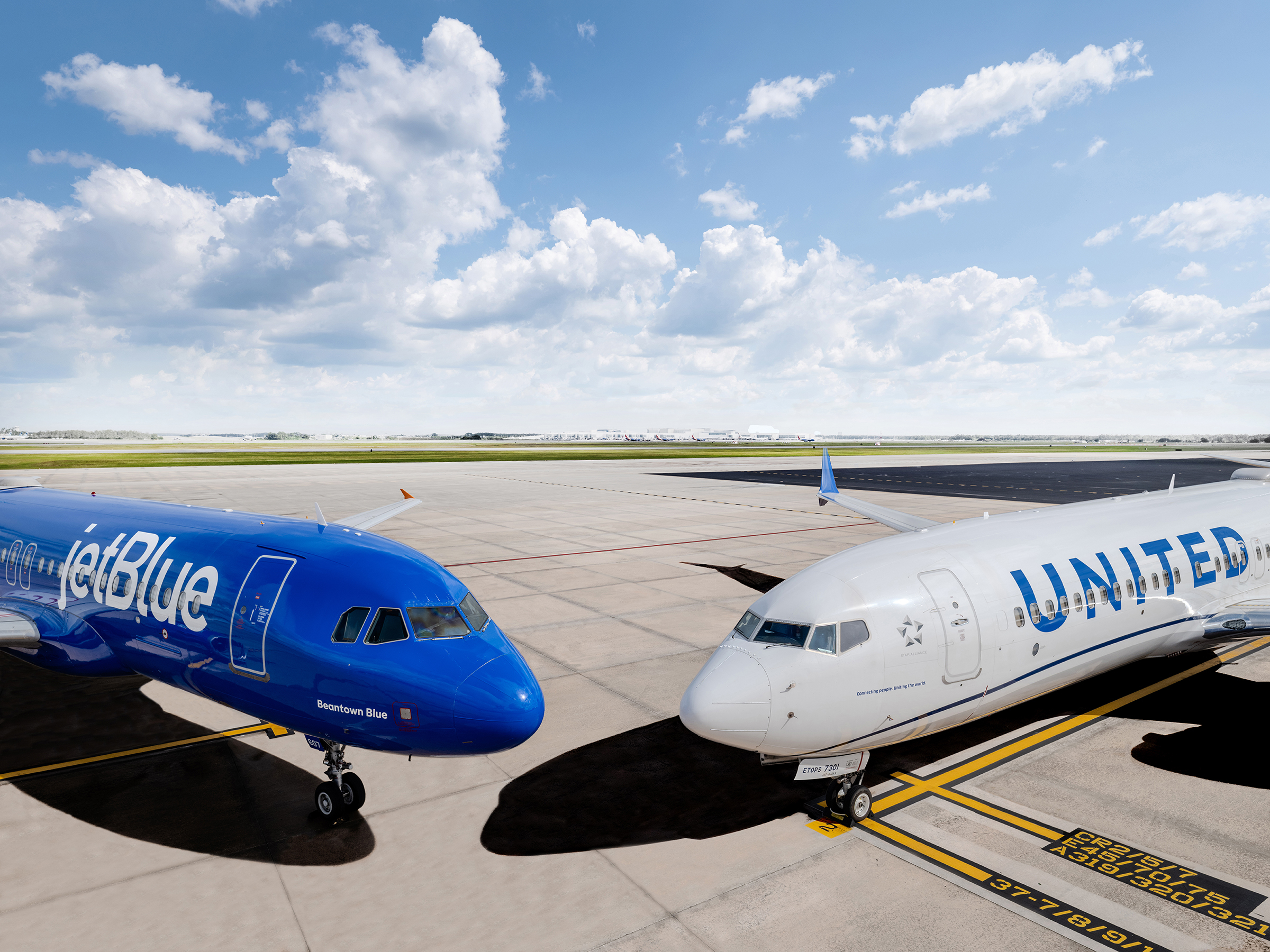
A combination of United Airlines and American Airlines would lead to an enormous new US carrier which would dominate the domestic market and would create areas of high passenger concentration at key airports, according to AE+ analysis, a consultancy that is part of Airline Economics, and official US data.
As stated in an earlier article published by Airline Economics - any merger between the two airlines would ring alarm bells with regulators concerned about competition and the pricing of air fares.
Analysis by Gary Crichlow, Appraisals Valuations & Lease Rates Team Leader at AE+ and data from the US Bureau of Transportation statistics for February 2025-January 2026 show just how dominant United-American airlines would be if the two were allowed to keep all their assets in terms of market share as they would be double the size of its two nearest competitors Delta and Southwest.
In reality for any merger to proceed would likely require a significant divestment of assets by the new entity to win regulatory approval.
Airlines | Airline Domestic Market Share February 2025 - January 2026 |
Combined United American | 34.1% |
Delta | 17.8% |
Southwest | 17.0% |
Alaska-Hawaiian | 8.0% |
jetBlue | 4.6% |
Frontier | 3.7% |
Other | 14.8% |
Source: US Bureau of Transportation Statistics
Key hubs
A potential combination of the two airlines would create either the leading carrier or a close second across multiple major US airports, raising significant competition concerns, according to AE+ analysis.
Particular scrutiny from regulators would likely home in on a number of key hub airports. In Chicago, both airlines operate major hubs, while in the New York area United’s strong position at Newark would be combined with American’s presence at JFK. In Los Angeles, a merged airline would significantly outsize Delta Air Lines, and in Washington, United’s hub at Dulles would be complemented by American’s dominant position at Reagan National Airport.
Such concentration across major metropolitan markets would be central to any antitrust review, given the potential impact on competition, capacity and pricing.
City | Current leading carrier (enplaned passengers both arriving and departing) | Current UA share & rank | Current AA share & rank | Combined UA-AA passenger share and rank |
Austin | Southwest (42.5%) | #4 (12.32%) | #3 (15.0%) | 27.3% (#2) |
Boston | jetBlue (27.3%) | #4 (11.2%) | #3 (13.5%) | 24.8% (#2) |
Chicago | United American | #1 (39.0%) | #2 (22.3%) | 61.3% (#1) |
Los Angeles | Delta 22.0% | #2 (18.0%) | #3 (17.7%) | 35.7% (#1) |
New York Area (JFK/LaGuardia/Newark) | Delta (incl subsidiary Endeavor Air) 26.7% | #2 (23.7%) | #4 (10.8%) | 34.4% (#1) |
Phoenix | Southwest (34.6%) | #5 (6.2%) | #2 (32.5%) | 38.7% (#1) |
San Diego | Southwest (34.5%) | #3 (12.6%) | #5 (11.7%) | 24.3% (#2) |
Washington DC area (Dulles / Reagan/Baltimore) | Southwest (31.6%) | #2 (19.5%) | #3 (11.6%) | 31.0% (#2) |
Source: AE+ analysis of US Bureau of Transportation statistics February 2025-January 2026
Scepticism about the merger
Meanwhile, a source expressed scepticism to Airline Economics about the likelihood of any merger between United Airlines and American Airlines securing regulatory approval, citing significant antitrust hurdles and expected opposition from competitors.
They said that even if US regulators were open to consolidation, a tie-up of two carriers of that scale would face “substantial resistance” from rival airlines and other stakeholders, given the impact on competition. They added that Delta Air Lines might be less vocal in its opposition, as it could benefit operationally in the near term from the disruption such a large integration would likely cause.
The same source suggested that raising the prospect of a United-American combination may be strategic, potentially helping to frame a smaller transaction, such as a bid for JetBlue Airways, as more palatable to regulators. A deal involving JetBlue could offer United greater access to constrained airports such as New York JFK while supporting a financially weaker carrier.
While a takeover of American under a “failing company” defence could theoretically be considered if the airline were in severe financial distress, which it isn’t, the source described such a scenario as unlikely under current market conditions, adding that a JetBlue acquisition appears a more realistic outcome in the near term.