

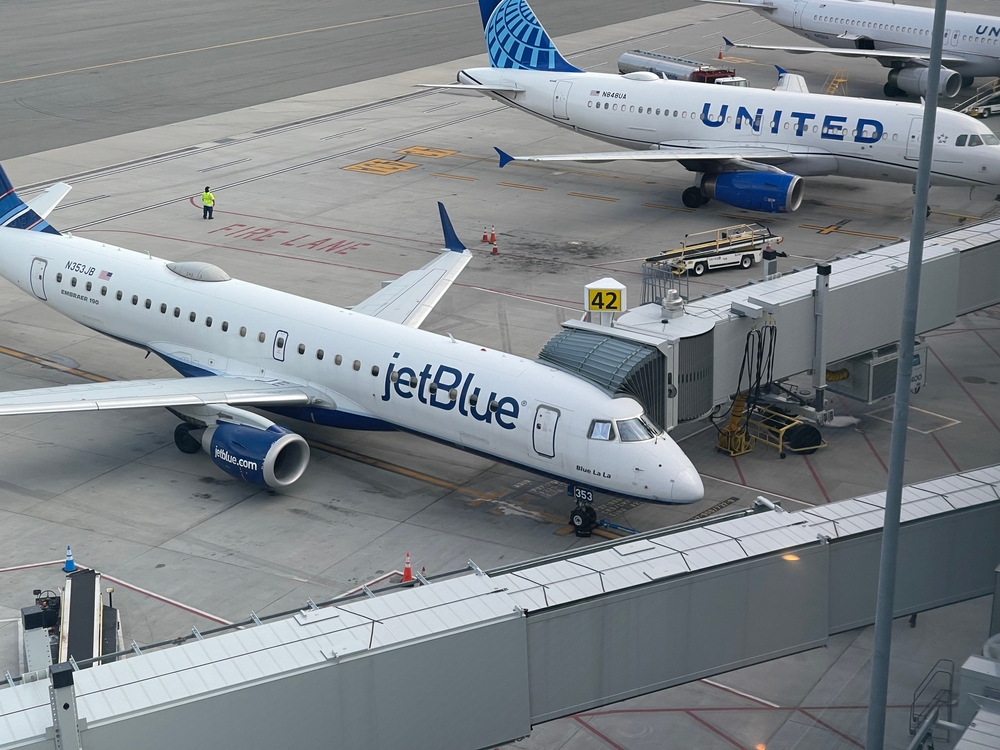
United Airlines and JetBlue have defended their proposed 'Blue Sky' alliance in a filing with the US Department of Transportation (DOT), reputing claims made by Spirit Airlines that this new venture would limit competition and increase air fares.
Spirit has claimed that the proposed collaboration between United and JetBlue risks replicating the same “anti-competitive incentives” that were included within the now-defunct Northeast Alliance (NEA) between American Airlines and JetBlue.
This alliance was dissolved after a trial in 2023 found it to be anticompetitive and was later upheld by a US appeals court in late 2023. American and JetBlue had been in discussions to form a new partnership, focussing on network and loyalty. Most recently the US Supreme Court rejected a request by American Airlines to overturn a lower court’s ruling which dismissed the partnership.
First announced in May, the new alliance between United and JetBlue is set to allow customers to purchase flights on both airlines through either carrier’s website or app. The partnership includes an interline agreement, rather than a codeshare, meaning each airline will continue to sell and market its own flights independently.
As part of the deal, JetBlue will provide United with access to slots at JFK International Airport, enabling United to launch up to seven daily round-trip flights out of JFK’s Terminal 6 from as early as 2027. The airlines have also agreed to exchange eight flight timings at Newark Liberty International Airport as part of a net-neutral adjustment.
Within a filing to the DOT in June, Spirit claimed that JetBlue, “drawn by the appeal of offering its customers access to United’s significantly larger global network”, risks becoming a “de facto subordinate” to United. The filing also stated that the alliance would create an unfair market advantage in the northeast region of the US, dominating routes to destinations such as Florida.
In response to claims made by Spirit, United and JetBlue said this new alliance has been structured to preserve robust competition between the two carriers, while also being designed to avoid the competitive concerns that arose from the NEA.
“The Blue Sky arrangement is not a metal-neutral joint venture. It includes no revenue sharing, no joint network planning, and no coordinated schedule optimisation,” United and JetBlue said. “Each airline maintains its independent operations and strategic autonomy. Their respective incentives remain unchanged - both United and JetBlue retain strong economic motivations to compete aggressively on price and service, not only with each other but across the broader market.”
The filing also notes that Spirit “inaccurately conflates interlining with codesharing”, highlighting that this deal involves only interlining - the most basic and arm’s-length form of airline cooperation - and does not include any codesharing, contrary to claims made in Spirit’s filing.
The carriers said that they both maintain interline agreements with “dozens of carriers”, including other US airlines. “Spirit’s attempt to blur these definitions and mischaracterise the nature of the collaboration between United and JetBlue is misleading and should be disregarded,” the filing read.
The two airlines noted that Blue Sky aligns with the precedent of previous arm’s-length domestic airline collaborations that the US Department of Transportation (DOT) has routinely reviewed and approved, citing the Alaska-American West Coast International Alliance (WCIA).
United and JetBlue urged the DOT to dismiss Spirit’s complaint and to close the docket without further action.