
As trade tensions between the US and China continue to escalate, two Boeing jets - one already returned and another currently en route - have been sent back to the manufacturer's facility in Seattle.
This is the latest development in the ongoing trade war between the US and China, which was triggered on April 2, 2025, after US President Donald Trump initiated sweeping global tariffs on economies around the world. China remains the only country currently facing US tariffs, following President Trump’s 90-day tariff freeze on other countries. In response to Washington’s 145% tariffs on Chinese imports, Beijing raised its own levies on US goods to 125%.
The two aircraft have been returned from Boeing’s 737 completion and delivery centre in China, located in Zhoushan, which is a joint venture with the Commercial Aircraft Corporation of China (COMAC). At the facility, 737 MAX aircraft are fitted with interiors and have airline liveries for Chinese customers sprayed.
Data from AirNav Radar shows that two aircraft have now departed from the Boeing completion centre.
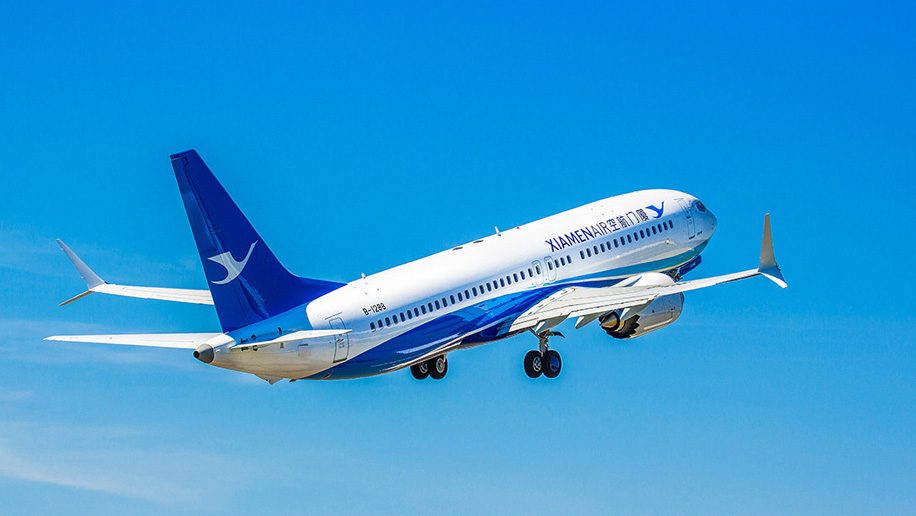
The data shows that the first 737 MAX 8 aircraft departed Zhoushan on April 18, 2025, bound for the US territory of Guam. The following day, the same aircraft continued on to Honolulu before completing its final leg to Boeing’s facility in Seattle.
The aircraft, which was meant for Xiamen Airlines, landed in Seattle at 6:11 pm local time, according to a Reuters witness, who photographed the aircraft painted with a Xiamen Airlines livery.
Images of the aircraft from 2018 show it painted with an Air China livery. More recently in 2024, it was pictured in the livery of Jinan-based carrier Shandong Airlines.
A second MAX aircraft with the registration N242BE arrived in Guam on April 21, 2025, again from Zhoushan, this aircraft is expected to follow the same trajectory as the previous aircraft, eventually arriving in Seattle.
A spokesperson for Xiamen Airlines has reportedly confirmed that two planes marked for the carrier have travelled to the US. Airline Economics has contacted the airline for comment.
This news follows a recent report from Bloomberg that China has told its airlines to stop taking deliveries of aircraft from Boeing, as part of reactionary measures to US tariffs. Citing people familiar with the matter, the media outlet stated that China has also asked that its carriers halt any purchase of aircraft related equipment and parts from US companies.
The Chinese government is supposedly considering ways to provide assistance to airlines that lease Boeing jets and are facing higher costs.
This move also follows reports that Juneyao Airlines delayed the delivery of one 787-9 aircraft due to US tariffs on China. Juneyao was reportedly expected to take delivery of the widebody aircraft in around two weeks' time but will now hold off. The aircraft is valued at $120 million
Boeing CEO Kelly Ortberg expressed concern to the US Senate Commerce Committee at the beginning of April over tariffs. He cautioned that these tariffs could hinder Boeing's ability to export its commercial airplanes. He emphasised that 80% of Boeing's planes are sold internationally, highlighting the importance of free trade for the company's operations.
Chinese carriers such as Air China, China Eastern Airlines and China Southern Airlines, reportedly have plans to take delivery of a collective 179 Boeing planes, in the next two-year period.
In response to these aircraft returning to Boeing, the Malaysia Aviation Group (MAG) - parent company of Malaysia Airlines - is exploring the possibility of accelerating its Boeing aircraft acquisition timeline, following delivery slots potentially vacated by Chinese carriers, MAG managing director Izham Ismail told Malaysian state news outlet Bernama.
Ismail stated that the group views the situation as a “potential window” to secure earlier- than-expected aircraft deliveries from Boeing, although competition among global carriers for available slots remains intense.
Airline Economics has contacted Boeing for comment.