
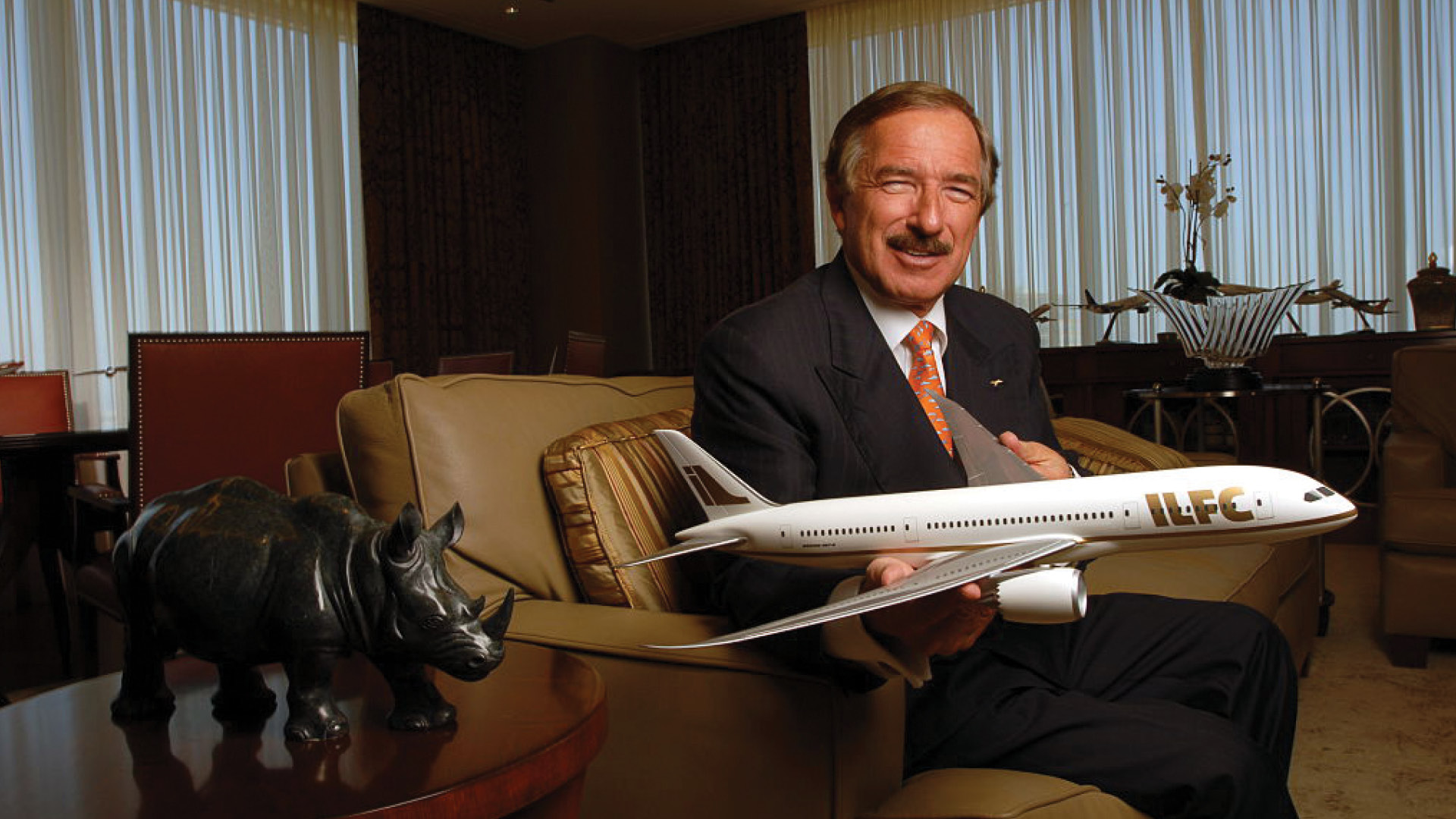
After announcing his decision to step down as executive chair of Air Lease, Steven Udvar-Hazy speaks to Victoria Tozer-Pennington about the pivotal moments of his career, from a young boy with a passion for aviation in communist Hungary to the creation of the global aircraft leasing industry, and navigating the challenges of the past 50 years in aviation.
Starting an airline was perhaps the most fortuitous mistake ever made by Steven Udvar-Hazy. After amassing a small fortune while still a college student by hustling airline consulting and brokerage gigs, Udvar-Hazy’s love of flying propelled him to take that hard-earned cash – with a little more help from family and friends – to launch Astro Air in 1969. The premise was to serve routes from Los Angeles to Lompoc and Santa Maria, using a leased Carstedt Jet Liner from Apache Airlines that could seat 15 passengers.
Udvar-Hazy realised very quickly that owning and leasing out aircraft was a much more profitable business. “The stupidest thing I ever did was start an airline when I was in my 20s,” shares Hazy. “I lost a lot of money and almost wiped out everything I had made. I realised that the guy getting the cheque at the end of the month for the lease of our airplane didn’t care how many passengers I had or if the weather was bad and I cancelled flights, he got paid the same amount every month. That’s when I realised being on that side of the street was a lot better than being an operator, which is the same today.”
That pivotal moment enabled Steven Udvar-Hazy to become a pioneer of aircraft leasing who proceeded to shape the fledgling industry into the multi-billion dollar global business it is today gaining him the moniker as the Godfather of Aircraft Leasing .
The Early Years
Steven Udvar-Hazy fascination for aviation began at an early age when his father took him to an airshow in his childhood home of Budapest, Hungary, which is where he developed a love of flight.
“Living in a closely controlled society, I felt that aviation was the highway to freedom,” he remembers. “There was really an emotional connection to aviation that’s hard to describe.”
Living under a communist totalitarian regime, airplanes and aviation provided a dream of escape. As a young boy, Udvar-Hazy would collect airline timetables from ticket offices in Budapest to study where they were flying and with which aircraft. “To this day I spend a lot of time studying where airlines fly, with what kind of plane and who they compete against.”
After the Soviet Union invaded Hungary in 1956, the family made the daring escape to the United States. In the 1950s, aviation history was being made. Only a few months after Udvar-Hazy arrived in the United States, Pan American World Airways (PanAm) flew the first 707 service and the first daily transatlantic jet service from New York to Paris on October 26, 1958. And only a few years prior to that, BOAC was enjoying commercial success with its Comet. It was an exciting time for a young boy.
When Udvar-Hazy moved to the US with his family in 1958, his emotional connection to aviation was nurtured by almost daily trips to the either LaGuardia Airport or Idlewild Airport (now called John F. Kennedy International) during the birth of the jet age.
“When I was 14, I would go to the airports and talk to my way into the control towers or talk my way to the hangars and I would make note of all the airliners, the type of airplanes and where they’re going, where they’re coming from.”
That fascination solidified into a dedication to pursuing a career in aviation, while his escape from an oppressive communist regime generated a deep-set realisation of the privilege he enjoyed in his new life in a free society where citizens had the freedom to explore the globe.
“I always felt that I was very lucky that I was able to get away from a totalitarian regime as a child, and I always felt that I owed something to society because of the privilege I had being exposed to aviation,” he says. “From a very early age, I was committed to do the very best I could to contribute back to aviation.”
After graduating from University of California, Los Angeles (UCLA), Udvar-Hazy started his career in aviation by capitalising on the jet aircraft boom. As aviation transitioned from propeller to jet aircraft, airlines needed a higher capital investment to purchase jet aircraft, which gave Udvar-Hazy the idea to start-up an aircraft leasing business.
Giving Back
Once Udvar-Hazy started having success with ILFC, his thoughts turned to how he could give something back to society. “My family and I felt that it was very important to get other children and young people interested and motivated in aviation and aerospace,” he says. “It became a mission.”
This mission and its expression through various philanthropic activities are central to the Udvar-Hazy family culture. “We understand and feel the need to share our success with others,” he says. “We have the opportunity to engage young people to be able to grow and prosper on their own once they develop that enthusiasm and love for aviation that I had as a kid.”
The Udvar-Hazy family made headlines in October 1999 when they donated $66 million to the Smithsonian’s National Air and Space Museum, now named the Steven F. Udvar-Hazy Center. The donation was the largest received from a single donor in the Smithsonian Institution’s long history, which saved the project.
ILFC – Building the industry
After refilling his coffers with further airline consultancy work and assistance from his partners, friends of the family Leslie and Louis Gonda, Udvar-Hazy created International Lease Finance Corporation (ILFC) in 1973. Two years later, Aft. These two fledgling companies would define the industry, creating a healthy rivalry between the two companies in those early years of aircraft leasing. “This was a transformational period for leasing with two very creative competitors,” says Hazy. “There was GPA, with Tony Ryan and his descendants, which was essentially the University of Aircraft Leasing in Ireland, and there was ILFC. But we had very different approaches and philosophies to the business.”
At the time the two fledgling companies were created, aircraft leasing was limited to airlines leasing used aircraft over short terms to other airlines. “They were all small transactions with one or two used aircraft – Boeing 707s, DC9s – that were traded, leased and financed,” says Hazy. “Although this was a fine business model if you were selected and careful, we felt that new aircraft could provide an entry into airlines that previously would never consider leasing an aircraft.”
At the time, large flag carriers tended to own their aircraft, financed by banks with export credit or manufacturer guarantees. “We felt that if we started to buy new planes speculatively that would open up a whole new collage of airline customers that up until then wouldn’t even talk to us.”
ILFC placed its first new aircraft order from Boeing in 1977 – a year before deregulation of the US airline industry – a brand new 737, which the team leased to Britannia Airways in the UK. “We bought the plane for $7.5 million – you cannot even buy an engine for that today – and were able to lease it out at more than $100,000 per month.” With an enviable lease rate factor of 1.3%, which is probably about double most sale-leaseback transactions closed today. But Udvar-Hazy is quick to point out that the interest rate on the loan was much higher than today at around 8-9%.
Gaining access to top tier airlines was only the first hurdle, convincing the manufacturers to allow a lessor to order aircraft was another, but gaining access to affordable financing was a significant obstacle.
“At the very beginning, banks would only give us money if we had a valid lease with a credit worthy customer, and on a lucky day, we would get 60-65 maybe 70% of the value of the plane,” remembers Hazy. “Usually, the financing term was no more than five or six years - so like a car loan. The banks wanted to get out fast. But on a new plane, like a 737 or a DC9, we had to do secure a longer lease to be able to justify the deal, so more like seven or eight years. The bank financing was contra to that, because the amortisation in some cases would be faster than the lease payments so we had to put money in ourselves.”
Financing in the late 1970s was difficult since loans were single loans on one asset and were generally priced at a floating rate. Udvar-Hazy recalls towards the end of the decade that Jimmy Carter’s attempt to stem inflation by rising interest rates resulted in the first crises for ILFC. “At the end of 1978, Carter let interest rates run away and they rose from around 9% to 19%, which increased our interest expense and debt service on our individual plans to more than the rent,” says Hazy. “We had to get loans to cover the shortfall. We didn’t know how long this would last but we knew in six months we would be bankrupt if it continued. Fortunately, the Fed reduced the rates but we had learned a hard lesson. We realised that the only way out of this dilemma was to launch an initial public offering.”
ILFC – which was still a small company with only eight employees including the three founders – went to market with a public offering in 1983 that raised $26 million. “We had 114 underwriters because no one large investment bank wanted to take the risk,” says Hazy. “It was mainly retail orientated – retired pilots and mom and pop investors. The offering gave us that additional liquidity to stem those negative cashflows that encouraged our banks to be more flexible.”
Just two years after the public offering, Udvar-Hazy had a landmark meeting with Lewis Thompson Preston, the CEO of JPMorgan in New York, which changed the nature of the business. It is a conversation Udvar-Hazy remembers well since the bank offered ILFC a $5 million unsecured line of credit. “He granted that line of credit thanks to our 10 year track record without any loses, and since we had paid down our debt. This was monumental – up until that time not even airlines were granted unsecured lines of credit. JPMorgan remains our lead bank to this day,” says Hazy. “The symbolic value of the credibility this unsecured line of credit gave us was more important than the money.”
Between the public offering and becoming an unsecured borrower, Udvar-Hazy quickly realised the benefits of building scale.
At this time, the aircraft leasing industry was still in its infancy – representing less than 2% of the world fleet. With his bid for scale, Udvar-Hazy began negotiations with Boeing for an order of 130 brand new planes – 737s, 757s and 767s. “Everybody thought I was completely insane,” he says. “But I felt that by building a large fleet of new aircraft, ILFC would be able to differentiate itself from GPA, which still hadn’t gone public at that time. I felt that by placing such a large order, I could gain access to first and second tier airlines, which boosted by our IPO and bank funding would fundamentally change the industry.”
The speculative order with Boeing was another pivotal moment for ILFC and for the leasing industry. At the beginning of ILFC, Udvar-Hazy candidly notes that the team were picking up business mostly from charter airlines and “picking up scraps” from the mainline airlines. He was convinced that having a large, new airplane fleet would change the dynamics of the leasing industry. Before that came to pass, two events changed the industry and ILFC’s fortunes once more. In 1990, US insurance firm American International Group (AIG) acquired ILFC, and two years later ILFC’s great rival GPA began to struggle following a failing public listing.
“AIG was a triple-A rated company that bought ILFC for $1.3bn, with shareholders offered stock or cash,” shares Udvar-Hazy. “I elected for a combination of cash and stock – and their stock performed really well with the market value almost doubling in four years.”
Since AIG didn’t know the business, Udvar-Hazy and the team were left to run the business as they had before the sale, “so long as we send them a dividend cheque, they were happy and stayed out of our business,” he says.
For Udvar-Hazy, gaining such a strong parent company on top of the unsecured lending and funding boost and the large aircraft order, gave the company even more credence in the marketplace. He describes it as a “triple halo” effect. “The unsecured financing, the bulk order, and having a large shareholder umbrella, was a kind of a triple credit halo that really helped us to move forward and gave us a lot of credibility. After that we just kept growing.”
In June 1992, GPA’s long-touted initial public offering (IPO) failed to attract investors and the planned flotation was cancelled at the last minute. Confidence in the company eroded almost overnight, and a year later General Electric (GE) acquired a majority share.
Udvar-Hazy remembers the time well. “They lost of lot of money on that project but the timing was not ideal and it was humiliating for Tony (Ryan), who was a great innovator and visionary.”
The elimination of ILFC’s key competitor from the industry assisted with the growth of the company, which by the time of the financial crisis in 2008 had a fleet of more than 1100 aircraft and a market capitalisation of approximately $40bn.
The Great Financial Crisis in 2008 heralded by the US subprime mortgage crisis put immense pressure on Wall Street and around the world that caused a global credit crunch as banks withdrew lending. AIG Financial Products (AIGFP), AIG’s financial division, was caught up in the maelstrom having guaranteed third party subprime debt. When foreclosures reached a peak in 2007, AIGPP was forced to pay the claims incurring $25bn in losses and was in danger of immediate insolvency. Since AIG also insured many investment bank CDOs, the company was declared “too big to fail”, ultimately resulting in the US Government having to step in with a $150bn bailout package to help stem the destruction of the US financial system. With the US Government now a major shareholder of AIG, ILFC effectively gained a new owner, which knew nothing about aircraft leasing other than the value of the assets.
“Once the government kicked out the AIG management, it became very active in our business,” remembers Hazy. “The US government came in and put a mortgage on every plane, so we couldn't move a plane from France to Italy to re-register it. These were bureaucrats that just graduated from college who didn't know anything about leasing. As a result we then we couldn't sell any assets. We had an offer from an airline to buy three of our A320s but we couldn't do it because the government refused saying that's our property.”
Udvar-Hazy became increasingly frustrated by the government interference and limiting restrictions placed on ILFC that he tried to buy the company back. “We offered $6bn to buy ILFC but the government refused on the grounds that the fact that I was a major shareholder and founder created a conflict of interest since as an ‘insider’ I had some kind of advantage over the taxpayer.”
Taking many trips to Washington DC and the Federal Reserve in New York City, Udvar-Hazy tried for almost a year to buy the company back from the US Government but was resisted at every turn. Finally exhausted by the situation, Udvar-Hazy called time on ILFC. “We had a family summit at Christmas 2009 in Beverly Hills where I shared how stupid the situation was where I had worked all my life to create an industry and some low level bureaucrats were preventing us from reinvigorating ILFC,” he says. “That’s the moment I decided to retire. I didn’t have an employment contract so I called our lawyers in Delaware and we formed Air Lease Corporation.”
In February 2010, Air Lease Corporation (Air Lease) was incorporated in Delaware by Udvar-Hazy and John Plueger – a brand new leasing company born out of the ashes of the financial crisis.
“Everybody thought I was crazy again to start a new leasing business when the airline business and the financial industry was in such a mess,” says Hazy, “but the best time to start a business is at the bottom of the valley not at the peak. When you are on top of the mountain you can only go down.”
Although Air Lease had solid support from his financiers, primarily faithful banking partner JPMorgan and several private equity firms, Udvar-Hazy was advised to ensure he personally has skin in the game. “We were advised to be heavily invested in the new business so I put in $100 million and raised $1.2bn from other equity investors,” he shares. “This was the only way to get a running start.”
Air Lease bought its first aircraft in May 2010 – a brand new A320ceo – and by April 2011 the company went public on the New York Stock Exchange (NYSE). Becoming publicly listed after just 11 months of operations was an unprecedented achievement, and the team kept on that steep growth trajectory. “Eleven months after we bought our first plane, we raised another billion dollars of equity, which helped secure our credibility with Boeing and Airbus,” says Hazy.
Air Lease placed an order for up to 20 Embraer jets at the Farnborough Air Show in 2010 and continued to build its new orderbook with orders for up to 33 Boeing 737-800s and 777-300ERs aircraft and up to 50 A320neos – the newly launched reengined A320 – at the Paris Air Show in June 2011. Air Lease also boosted its portfolio with ATR orders in 2013-4.
“We created our portfolio with the aim to creating a $10bn company within three or four years following its launch – and that is exactly what we did,” says Hazy. “The tragedy in the US financial system that entangled AIG was the catalyst for Air Lease, otherwise today ILFC would have been a $100bn leasing company. Sometimes it takes a tragedy to create a change of course.”
Some may attribute the success of Air Lease to fortuitous timing and an element of luck but Udvar-Hazy emphatically attributes its success to “experience and instinct” and stresses that both are essential. “We are probably the most customer-focused leasing company,” he says. “Every time we meet with an airline, we are thinking about the best solution for their fleet, their network, and their business model. It’s not making the last dollar; we focus on the best long-term solution for that airline’s operations and competitive environment.”
Udvar-Hazy’s dedication to his airline customers is clear. At the time of this interview, he shared that he had just returned from a multi-stop trip. “Monday, I was in Spain, in Palma de Mallorca. Then on Tuesday and Wednesday, I was in the Seychelles in the Indian Ocean. Then yesterday, I was in London, and now I'm in Dallas. This is a typical week. I spend most of my time with airline customers and the manufacturers.”
Udvar-Hazy is able to maintain such a punishing meeting schedule only because, as a veteran pilot, he habitually flies himself around the world to ensure face-to-face time with his customers. That dedication to his customers is frequently demonstrated by long-time airline CEOs, who acknowledge Udvar-Hazy’s particular assistance during times of crisis. At a recent aviation conference, Andrés Conesa the CEO of the Mexican airline Aeroméxico, reminded the audience that he had known Udvar-Hazy for half a century having leased a DC8 aircraft from him for the first time in 1973 that spawned a relationship covering a myriad aircraft types from MD80s, 777s, 787s, and several chief executives. Aer Lingus is another long-time customer – a relationship that began while Udvar-Hazy was still at school when he was brought in to consult on their fleet plan. “I was still at university when I was hired to provide a fleet plan for the airline because it had too many aircraft types – they had 30 planes and six or seven types,” he remembers. “They adopted the fleet plan I came up with and we became very close over the years. So when the airline had liquidity issues and the government and other banks refused to help, I flew over to meet with CEO Willie Walsh and provided a solution. I agreed to buy all the airline’s Boeing 737-500s and -400s for cash and leased them back over the short term, while securing subsidies off Airbus to ensure Aer Lingus signed up for new leases for the A320. Willie still recalls how we helped save the airline. And when Aer Lingus wanted to operate new A320neoLRs, they came to us – the California boys – not the Dublin lessors, which demonstrates the depth of our relationship.”
With such a depth of airline relationships, while at ILFC Udvar-Hazy was courted by former Airbus CEO Jean Pierson and sales chief John Leahy to expand Airbus aircraft to more Boeing-only operators. “Jean Pierson and John Leahy believed that the leasing industry could increase Airbus’ market share compared to Boeing and McDonnell Douglas by bringing in smaller airlines new to the brand and they entrusted us to develop a broader market presence for the Airbus,” says Hazy. “We thought there was a need for a smaller plane than an A320 so I was negotiating with Airbus to launch the A319. Jean didn’t want to do it but at the Paris Air Show in 1993 I told him that we would launch the programme with six orders having already placed the first three. Jean agree to the launch but doubted they would get more than 300 orders. Leahy saw more potential and thought they might sell 600 but I said they would sell more than 1,000, which they exceeded.”
As an aircraft owner and lessor, Udvar-Hazy points out that he is always looking at the mission requirements for his airline customers whereas the manufacturers are weighing risks, costs, and certification problems. Udvar-Hazy’s understanding of his customers’ needs again proved invaluable when he convinced Airbus of the need for a long range A321. “Airbus originally only wanted the A321 for intra-Europe operations for flights under three hours. I pointed out that they had no real competitor aircraft to Boeing’s 757 and although the A321 was a great aircraft it needed to be more versatile. They eventually were convinced to develop more variants including the neo but we had to kill them to develop the LR version. Airbus didn’t want to develop an LR version due to the expense of adding extra fuel tanks, and they didn’t want to develop the XLR as they were already having production problems and supply chain issues.”
Airbus was convinced to launch the XLR when Air Lease placed a large order at the 2019 Paris Air Show. “JetBlue, Air Canada and American followed with large orders but, every time, convincing the manufacturers to launch a new aircraft has been like pulling teeth without novocaine,” says Hazy, sharing a similar experience with Boeing on its decision to launch the stretched 787-10. “I am the only crazy person that goes out on a limb with the manufacturers, fighting battle after battle, until three years. Later, they wake up and see that what I have been saying makes sense.”
Customer loyalty under pressure
Udvar-Hazy’s level of customer dedication was put under immense pressure during Covid: “The pandemic was a real test because so many of our customers were really struggling,” he says, “and we had to pick and choose those to support in a big way and those we could afford to support in a small way.”
He shares further that support was not always financial, for example the team worked to pressure government shareholders of their airline customers to provide assistance such as relinquishing payment of landing fees, or other charges, for a period of time. During the depths of the pandemic air travel was effectively grounded without a clear end date. It is no surprise that Udvar-Hazy calls this the most stressful period of his career. “My wife compares that time akin to running a hospital. The different coloured ambulances were arriving every five minutes bearing the logo of another airline. The calls would come in at one, three, and five in the morning – it was a non-stop emergency and we had no idea how long it would last. That was the biggest stress point – we didn’t know if we had the staying power to survive for a couple of years.”
Thankfully the situation recovered more quickly than expected but the period was a real test. “This wasn’t something could have been learned in school – there was no way to prepare for such a situation other than having a lot of liquidity and financial strength.”
During the pandemic period, Udvar-Hazy saw how the industry was disconnecting as face-to-face meetings were restricted and the world pivoted to online. “The aviation industry is huge but also relatively small – there are maybe a few hundred key decision makers if you combine the OEMs, airline CEOs, leading bankers and lessors. I saw during Covid a disconnect happening between airlines and lessors as they weren’t able to meet in person. I made full use of my EU and US passports as well as my Captain’s uniform to ensure I could continue to meet with as many of my customers as possible.”
Following the pandemic, Air Lease benefitted from the support provided to its customers. Udvar-Hazy describes the loyalty the company gained from its airlines as “unbelievable”. He and the Air Lease team remain focused on finding creative solutions for their airline customers. “We try to be imaginative and creative and originate deals with solutions rather than playing in the vanilla sale-leaseback space where the lowest lease factor and worst return conditions win.”
Overarching passion for aviation
Udvar-Hazy’s passion for planes and the aviation industry he has helped to shape for the past 50 years is undiminished despite his decision to pull back from the forefront of managing Air Lease. In fact, his passion is what prompted the decision to formally retire as the executive chairman of Air Lease earlier this year. “People ask me how I can maintain such a punishing meeting schedule without being fatigued,” he says. “I don’t see it like that, I see the adventure and the fun of the game. In late February I sat down with my board of directors to map out a pathway to provide opportunity for our younger executives to grow in stature without running to me to solve every problem. I want to be the last step in the decision process not the first and allow others to come up with more creative solutions.”
With such a wealth and depth of industry experience gained by starting a business – even an entire industry – from scratch enables Steve Udvar-Hazy to see solutions more rapidly than others but what he wants now is to enable his successors to gain their own experiences by making those key decisions. “That’s the motivation to retire at this time,” he says, “not that I’m tired or fatigued. I have no health issues and have never been sick. This is a good time. We have achieved great things. Our insurance situation looks very solid and the industry has recovered well, yields are recovering. The OEMs are struggling but those issues will pass. We’re going through some transitions but I have seen the movie and I’d like to take one step back – but still be accessible should the business need me.”
Udvar-Hazy’s customer dedication has shone throughout this interview, which is his main advice for his executives but he also stresses the need to remain calm in a crisis and keep one eye on the journey. “Think long term and don’t become overwhelmed by today’s crisis or challenge because by overcoming it you will become a better manager,” he advises. “For young people, I would also advise to set three goals – short-term, medium-term and long-term goals – but always keep in mind your long-term path.”
Achieving his short-term goal of starting the airline he always dreamed of owing in 1969, ultimately set him on the longer path of building a career at the top of an industry he helped to create for the past half a century, and counting.