

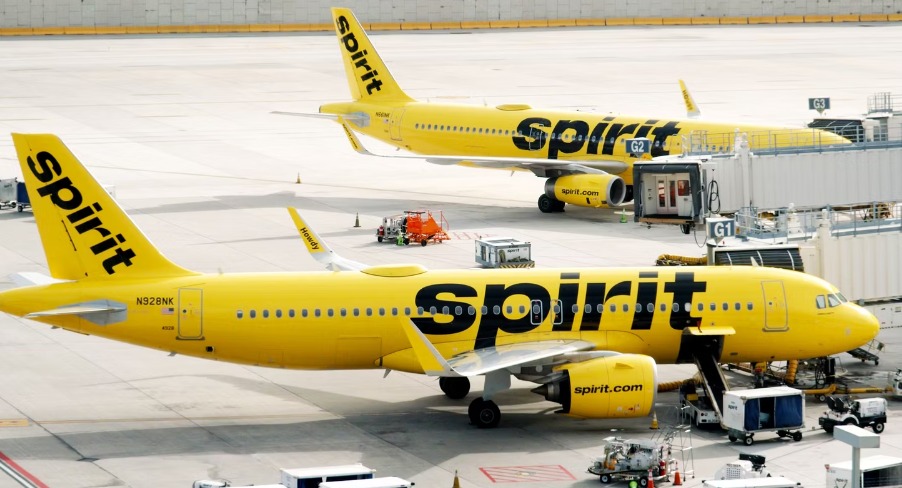
Spirit Airlines' liquidity pressures are weighing on its operational outlook, with the company flagging a “going concern” in its second quarter results filing on August 11, 2025.
“Management has concluded there is substantial doubt as to the company's ability to continue as a going concern within 12 months [from the filing date]," Spirit said.
Spirit said it continues to be affected by these “adverse market conditions” including the domestic leisure demand weakness and higher competition. This comes amid mounting economic uncertainties in the industry, which has particularly impacted domestic travel demand in the US. Other carriers, despite demand slip, have been buoyed by international and premium sales, with loyalty programmes providing substantial revenue streams.
The economic uncertainties were driven largely by US-led tariff conflicts. With Spirit’s all-Airbus fleet, the company warned that tariffs could further exacerbate its operational challenges.
Spirit said additional charges related to tariffs, along with “continued uncertainty surrounding such policies” could lead to, “further weakened business conditions for the transportation industry, which may adversely impact the company’s operations through increased supply chain challenges, commodity price volatility and a decline in discretionary spending and consumer confidence, among others.”
“Any tariffs are expected to increase expenses and may have an impact on demand,” Spirit said.
Spirit said it is continuing to monitor the tariff situation.
The warning follows Spirit's exit from Chapter 11 restructuring in March this year. As part of this, Spirit had restructured certain of its debt obligations, reducing its debt by around $795 million. In addition, the company launched its premium rebrand plan, supported by a $350 million equity investment from existing investors. The company’s reorganisation plan was confirmed by a US bankruptcy court in February 2025, with “overwhelming support from a supermajority of the company’s loyalty and convertible noteholders”.
The company said its premium offerings as well as sale and leaseback transactions for “certain” owned spare engines has aided in addressing the market challenges. In addition, Spirit enacted some other cost reductions such as furloughing 270 pilots (around 10% of staff), disclosed last month.
“After considering the measures taken, minimum liquidity covenants in the company’s debt obligations and credit card processing agreement require financial results to improve at a rate faster than what the company is currently anticipating,” Spirit read in its report.
As a result of this, Spirit said it plans to enhance its liquidity position by potential aircraft and real estate sales, selling off certain airport gate capacity, eliminating some fixed costs, as well as exploring other transactions. The airline is currently in discussions with “various stakeholders” regarding these initiatives.
“The company is also in discussions with representatives of its credit card processor, which has requested additional collateral to renew its credit card processing agreement,” Spirit continued. The agreement expires at the end of the year and the collateral required may result in a reduction of its unrestricted cash.
Spirit said that if these initiatives fail to better position its financial standing, management believe it is “probable” it will be “unable to comply with the minimum liquidity covenants under the company’s debt obligations and credit card processing agreement at some point in the next 12 months”. This would result in a default, which would accelerate the maturity of its debt obligations.
“Assuming management’s concerns pan out, we expect this creates vacuums in the domestic US and raises the floor on pricing,” said TD Cowen analyst Tom Fitzgerald.
He added: “Investors will need to monitor which routes the airline is exiting and which airlines may look to fill the void. For example, if Spirit were to shrink Detroit, we expect Sun Country may look to begin building a beachhead.”
Additionally, while Spirit’s exit could create vacuums for other low-cast carriers in the country, Fitzgerald said this could benefit and allow for further growth for airlines that have “outperformed” post-COVID, such as United or Delta.
Upon emergence from its Chapter 11 bankruptcy, the airline had cancelled its senior secured and convertible notes, issue $840 million of new senior secured notes due 2030 and entered a $275 million revolving credit facility. Spirit repaid and terminated its previous debtor-in-possession financing. Additionally, the company had reorganised its corporate structure with Spirit becoming the new parent company and ‘Spirit Airlines’ becoming a wholly owned subsidiary.
Total liabilities and shareholders’ equity totalled $9.4bn as of the end of the second quarter. The company reported a net loss of $245.8 million in the second quarter, or $7.24 loss per share, widening from its $192.9 million net loss, or $1.76 loss per share, pre-restructuring last year.
During the first half of the year, Spirit said it took delivery of three aircraft under sale leaseback transactions. As of the end of June, it had a fleet of 215 A320 family aircraft. Around 148 of which were financed under operating leases with lease term expirations between 2026 and 2043. The company owned 49 aircraft, of which none were unencumbered.
The company has total aircraft firm orders for 52 A320 family aircraft, with deliveries expected from 2029 through 2031. As of the end of June, the company said it did not have financing commitments in place for its firm order.
The company has agreements in place for 36 A320neos and A321neos to be financed through direct leases with lessors. Deliveries are scheduled between 2027 and 2028.
In addition, the company is required to purchase a certain number of spare engines to maintain a contractual ratio of spare engines to aircraft in its fleet as part of an engine purchase support agreement signed in 2021. The company is committed to purchase 16 PW1100GJM spare engines, as of the end of the quarter, with deliveries through 2031.
For the quarter, the company’s revenues totalled $1bn, down from $1.3bn a year prior. Operating expenses were down from $1.4bn last year to $1.2bn, resulting in an operating loss of $184.1 million.
Spirit had faced significant challenges last year following its failed merger with JetBlue after the US Department of Justice (DOJ) blocked the move, before both airlines agreed to cancel the deal. Later in the year, Spirit and Frontier had a back and forth over a potential merger, with Frontier believing the airline to have over-estimated its value before Spirit ultimately deciding to independently proceed with its premium rebrand plan.