

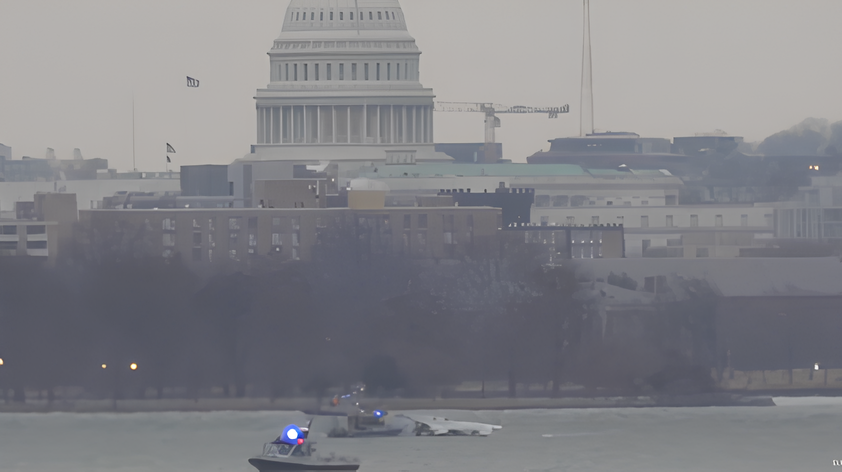
US Transportation Secretary Sean Duffy said on March 11, 2025, that changes will be made “permanent” to prevent helicopter traffic near Ronald Regan National Airport (DCA), following the mid-air collision of an American Airlines jet and a US Army Black Hawk helicopter in January.
A preliminary report published by the National Transportation Safety Board (NTSB) into the incident recommended that helicopters should avoid flying near Reagan National Airport when two lesser-used runways are in operation. The report cited concerns about airspace congestion and potential conflicts between rotary and fixed-wing aircraft.
During a press conference, Duffy said that it is time to “implement change”, referencing data from the Federal Aviation Administration (FAA) that recorded 85 near-miss incidents involving helicopters and aircraft at the Washington airport over the past two years.
“The question is how the FAA failed to recognise this as a hotspot for near misses. If we do not change our ways, lives will be lost," said Duffy.
The Transportation Secretary also confirmed that in addition to restricting helicopter flights near DCA, the FAA will establish an alternative helicopter route to be used when the lesser-utilised runways are active. Duffy stated that restrictions on helicopter traffic were implemented within 36 hours of the mid-air collision on January 29, 2025.
The collision involved an American Airlines flight that was travelling from Wichita, Kansas to DCA when it collided with a US Army Black Hawk helicopter while on final approach to the airport. All 64 passengers and crew on-board the jet lost their lives, along with three people on the army helicopter.
In the wake of this accident, and a series of incidents and near misses across the US in previous weeks, Duffy turned his focus to an urgent need to upgrade the country’s “antiquated and old” air traffic control (ATC) system. The modernisation process, set to take place over the next three to four years, will involve replacing copper wiring with fibre optics and integrating satellite technology.
In the coming weeks, a comprehensive plan for ATC renewal will be developed and presented to Congress for approval.
Last week a US House of Representatives subcommittee heard how the FAA is spending an additional $7 million per month just to maintain legacy copper wire as they delay the fibre optic upgrades due to insufficient funding. He noted that other FAA programs will continue to suffer funding cuts if this program is not adequately funded.
At a minimum, the FAA is said to need $212 million just to sustain current surveillance systems, as many components of legacy radars are past their end-of-life cycles and are no longer manufactured.
The transportation agency said it has “accepted and adapted” the NTSB’s preliminary crash report recommendations accordingly.