

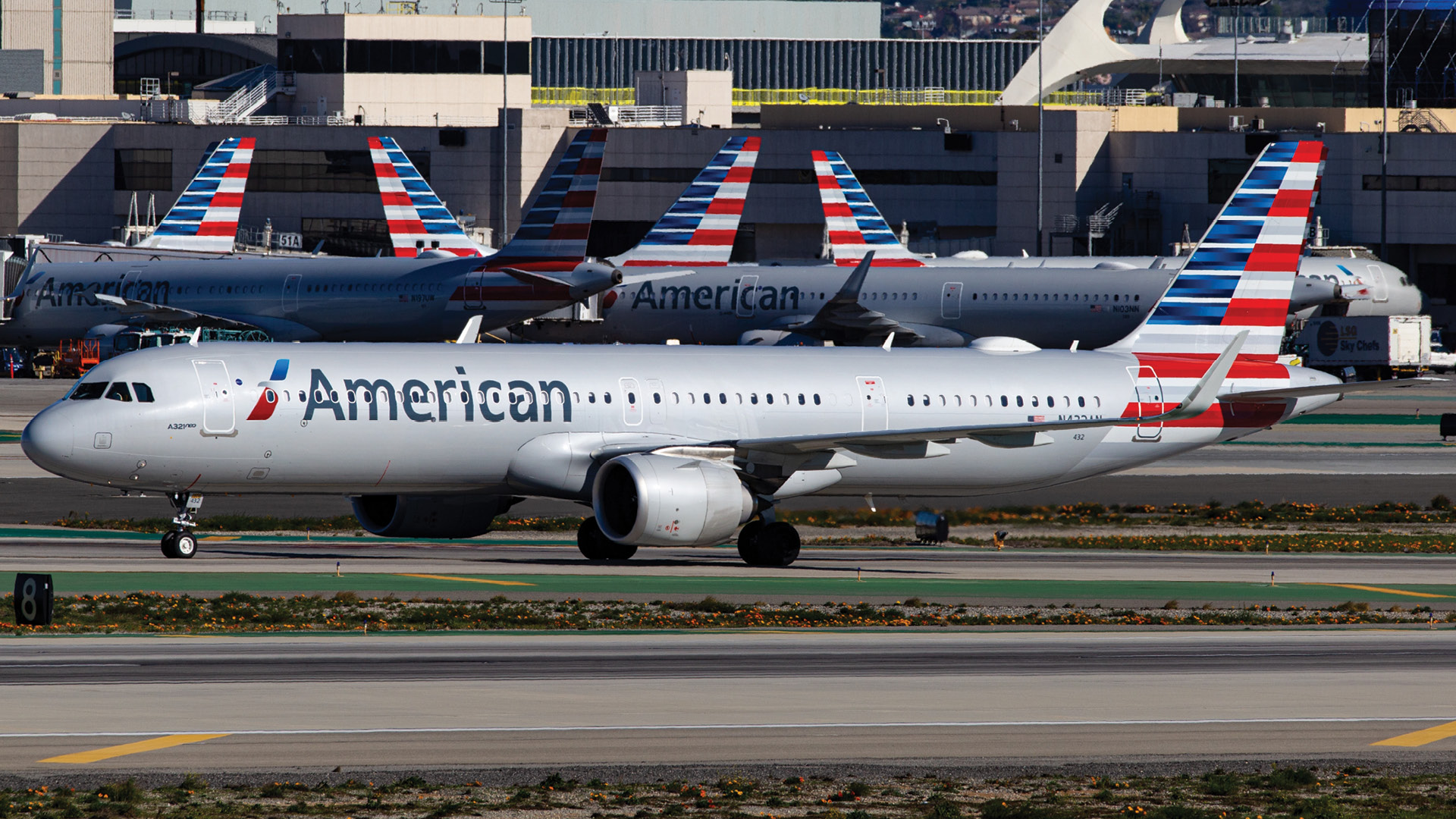
Clemens Metz has been promoted to vice president and treasurer at American Airlines.
"Clemens has played a key role in strengthening our financial position, including efforts to reduce debt and enhance the balance sheet," American announced on March 24. “In his expanded role, he will lead American’s corporate finance, banking, asset management and insurance work.”
Metz joined the company in 2020 as director, corporate finance & treasury until 2022 where he was named managing director, corporate finance & treasury. Speaking to Airline Economics , Metz confirmed that the airline will look to fill his position in the next couple of months.
Metz succeeds Meghan Montana who will now serve as SVP of finance, where she will govern all internal finance functions including financial planning, budgeting, and capital forecasting. Montana will also continue some external facing functions such as the OEM relationships.
American chief financial officer Devon May had held the role of SVP of finance prior to his promotion of CFO in 2023. Metz will report to May in his role as treasurer.
Metz said that Montana had been a “great mentor” throughout his journey at American.
Following his promotion, Metz will now oversee functions including insurance, asset management and cash management on top of his financing responsibilities. “The core treasury functions sit with me,” said Metz.
Metz’ promotion comes at a pivotal time for the company, which has been proactively reducing its debt.
American Airlines had a total debt of $38.6bn at the end of 2024. American’s net debt was $31.6bn, which the company said was its lowest since 2015. During the fourth quarter, the airline prepaid $750 million of near-term debt maturities and repriced two term loans.
“We achieved our total debt reduction goal of $15bn from peak levels in mid-2021 a full-year ahead of schedule,” said May during the company’s annual earnings call for 2024. Peak levels had reached a total debt of $54bn.
After reaching its goal a year early, the company brought forward its target of a total debt below $35bn a year earlier to year-end 2027.
“We have a good path to accomplish that by 2027 and we are committed to it,” said Metz.
American CEO Robert Isom said during the JP Morgan Industrials Conference in March that the company does not have “extraordinary capital requirements coming up” in 2025, with most of its fleet investment completed. “Ultimately, we’ve got a much stronger balance sheet and one that’s capable of weathering any type of storm that might be on the horizon,” said Isom.
Metz explained: “We’ve made a lot of progress on the deleveraging side, moving the balance sheet in the right direction, and the goal is BB flat credit metrics and ratings. That’s going to take some time. The debt pay down is helping us get towards that goal, but there’s still work to do and that’s why we have that additional goal.”
On March 24, 2025, American – along with its loyalty entity AAdvantage Loyalty – amended its term loan credit and guaranty agreement, repricing the company’s $2.3bn term loan under “substantially similar terms”, but with revised interest rates and repayment schedules.
Under the terms of the amendment, the existing 2021 term loans have been replaced with new loans of the same principal amount, but will bear interest at either a base rate plus a $1.25% margin each year or — at the borrowers' option — the three-month SOFR rate plus a 2.25% margin.
The scheduled principal amortisation payments have been reduced to 0.25% of the outstanding loan amount, payable quarterly beginning July this year. The replacement term loans will not be subject to a cost spread adjustment.
“We were excited about getting that repricing done,” explained Metz. “The term loan market has seen a lot of repricings over the last couple of years. We had to wait until now. This was a deal from 2021 and it was very expensive. It was a SOFR plus 4.75%, plus a credit spread adjustment. We took that down to SOFR plus 225 basis points, which is a huge reduction.
“The reason we had to wait that long was because it was a Covid deal. It still had some make-whole penalties and there would have been a penalty to reprice it. That penalty came way down at the end of March and was finally the point where we could reprice it with less of a penalty.”
Due to the term loan agreement being a Covid deal, it amortised 20% per year, which involved $700 million in annual amortisation.
“It’s a debt that we liked and we were happy to have it outstanding, and we changed the amortisation to what is standard for a term loan, which is 1% per year,” said Metz. “We went from $700 million amortisation per year to $23 million amortisation. We essentially reduced the payments per year by $675 million and allowed us to take advantage of a very constructive market backdrop: reduce pricing, reduce amortisation.
“It means we can revisit what we want to do with that debt over the next couple of years and see how much of that will continue to be part of the balance sheet.”
At the end of last year, American had also prepaid an unsecured instrument that was due to mature in March 2025. Metz said the company has “taken care” of most of its near-term maturities.
American’s $1bn 6.50% convertible notes offering, priced in June 2020, matures in July 2025 and is the last near-term maturity that is still outstanding.
“Based on where the share price is, we can choose to cash settle or share settle the notes,” he explained. “Based on today’s share price, the instrument will settle in cash. We’ll evaluate our liquidity target throughout the back half of this year to see if there are more incremental financings or not. We don’t have to refinance it as it matures because we have enough cash, but we want to make sure that we have enough liquidity on the balance sheet.”
The company will evaluate the macro backdrop and the economy’s performance before deciding whether it will complete more financings for the second half of the year.
The airline had noted a softness in domestic leisure segment for the first quarter of the year – primarily during March – with “economic uncertainty” at present. In addition, events such as the California wildfires impacted some of its larger hubs.
Capacity guidance was maintained at flat to a 2% increase, along with unit costs excluding fuel to be up high single digits. Isom said this “measured approach to capacity” has set up American well despite the current revenue environment.
“As the treasury team, it's my job to make sure we think about the market environment, the economy and react accordingly,” Metz said. “We're making sure that we have a balance sheet that gets us through any potential choppiness.”
Isom pointed out during the Industrials Conference that the airline had invested almost $30bn in aircraft over the prior seven to eight years up to the pandemic. He said: “We don’t have to go through that. Other [airlines] have a different path ahead of them.”
During the company’s fourth quarter earning’s call, CFO May said that the company expected 40 to 50 new aircraft deliveries in 2025, which would include American’s first A321XLR. Metz said the company expects the XLR “very soon”. The XLR will initially fly domestically, before gradually replacing the airline’s A321T. The XLR will be an important revenue driver for the company, he added.
American’s A321T aircraft are a transcontinental configuration of the Airbus A321, used on routes such as New York (JFK) to Los Angeles (LAX). The airline’s A321Ts will not be retired, but rather reconfigured and transferred to the company’s domestic routes. “These XLRs are growth really,” Metz continued. He added that the “true growth opportunity” for the XLR will be in 2026.
“I suspect later this year we’re going to start talking about the exciting stuff we can do with the XLR,” he said.
The company has 30 787-9 Dreamliners outstanding for delivery. Due to delivery delays from Boeing, the company had adjusted its summer schedule to circumvent the impact.
“We have a backlog of 787-9s that were supposed to deliver last summer that are finally supposed to deliver over the next couple of months,” said Metz. He added that the first delivery could come in the second quarter and the company could “finally get some widebody deliveries this summer”.
American had retired a lot of its widebody aircraft during the pandemic. “We thought they would get backfilled very quickly, but with delivery delays, that just never happened,” Metz said. He added that the 787-9’s high premium capacity would further push the company’s strategy to emphasise premium offerings.
Metz joined in 2020, at the height of the pandemic, and has helped steer the company through the challenge of Covid before very quickly setting out a long-term path to put the balance sheet into a more secure position following. He said the journey has been “incredibly exciting” and noted that American has continued to deliver on its targets set out in 2021. “It’s been fascinating to see that improvement,” he said. “As a company, we’ve gotten more resilient and the operation has improved significantly.”