

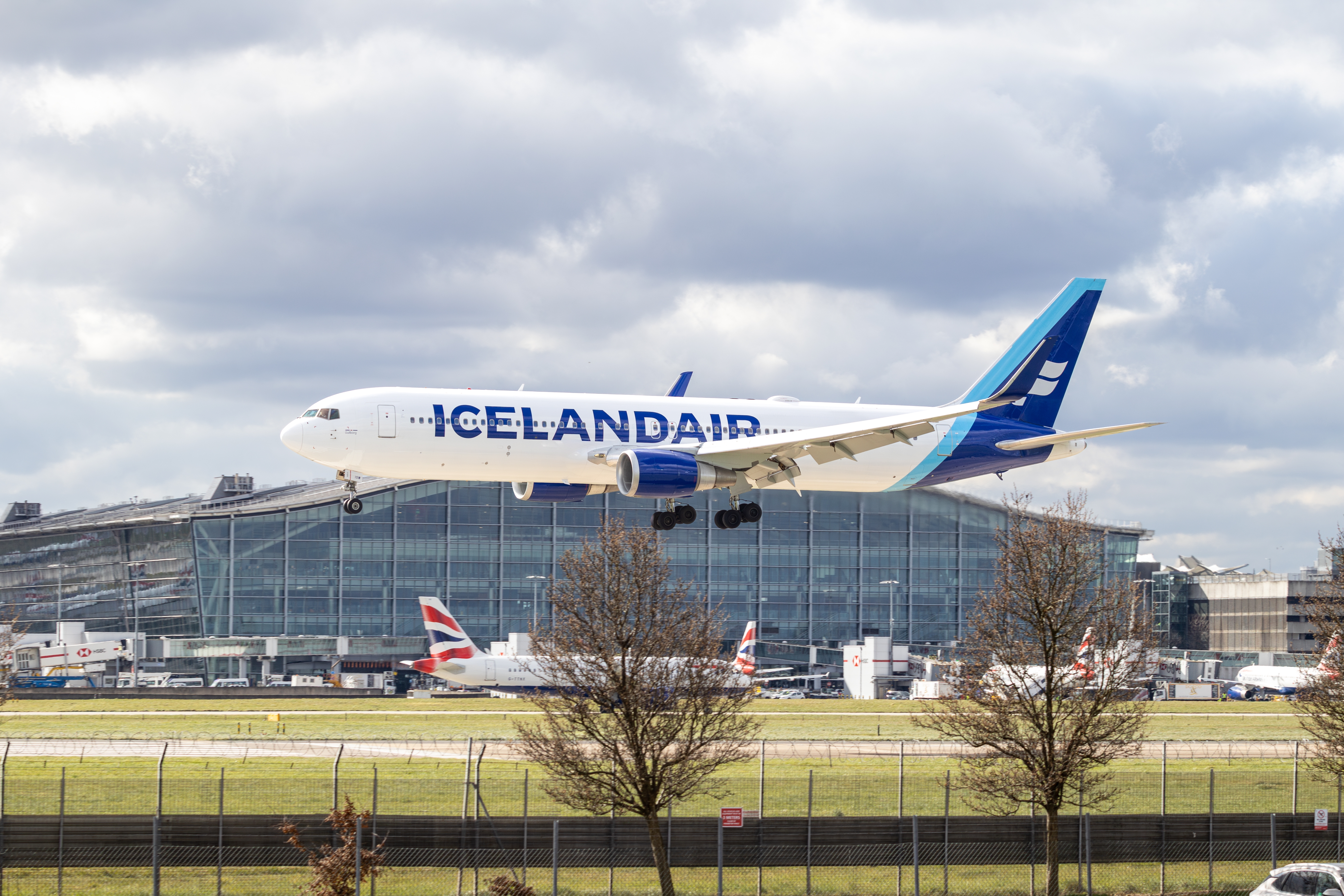
Icelandair will end widebody operations by the end of 2026 after eight years of "unsustainable financial performance", the company said in its third-quarter earnings report on Thursday (October 23).
The Iceland flag carrier said it will cease operations of its 767-300ER by the end of 2026, bringing this deadline forward from 2029, as it plans to reduce its fleet by two aircraft in 2026. Additionally, four 757s and one 767 will be retired by the end of this year as it transitions to a more “unified and fuel-efficient fleet”.
For summer 2026, the airline will operate 41 aircraft in its passenger network, including 21 737 MAX and seven A321LRs.
The move comes as the airline guides a full-year 2025 EBIT of negative $10 million to $20 million. The company noted pressures from currency exchange, salary cost pressures, and the global geopolitical environment impacting the result.
Icelandair is continuing salary negotiations with unions representing its cabin crew, and management has stated that it is “hard to say” when they will conclude.
Icelandair president and CEO Bogi Nils Bogason said, through its capacity rationalisation, the company is focussed on turning around performance to profitable operations “no later than next year”.
The airline said it will focus on point-to-point markets next year, pulling away from the competitive transatlantic market. Capacity is still expected to grow around 2% next year. The airline’s capacity grew 8% this year.
The airline had already disclosed in September that it would cut Detroit from its network next year, with North America proving a challenging market. During the company's earnings call, management said it was “quite likely the situation will be more balanced there in the future".
Fellow Icelandic airline PLAY Airlines ceased operations last month. “Our hub has strengthened as a result and brings us into a better position,” Icelandair management said in a call. The airline now has a 70% share of capacity at its hub, Keflavik International Airport.
“PLAY had already downsized quite a lot, so the change was not as big if it had happened a year or two years ago, when they were operating 10 aircraft,” said Bogason during the call. “The market is dynamic and there is still fierce competition, but our position has definitely strengthened.”
The airline reported revenues of $522 million for the third quarter, up 5% from last year. Unit costs were up 4%, while unit costs rose 6% amid a negative currency effect. The currency impact on EBIT was around $10 million.
Operating expenses totalled $464.6 million, increasing 9% from last year.
Net profits were down $12 million to $58 million and EBIT was $74 million, down from $84 million last year.
The airline said it expects three new A321LR aircraft to be delivered in the first quarter of next year.