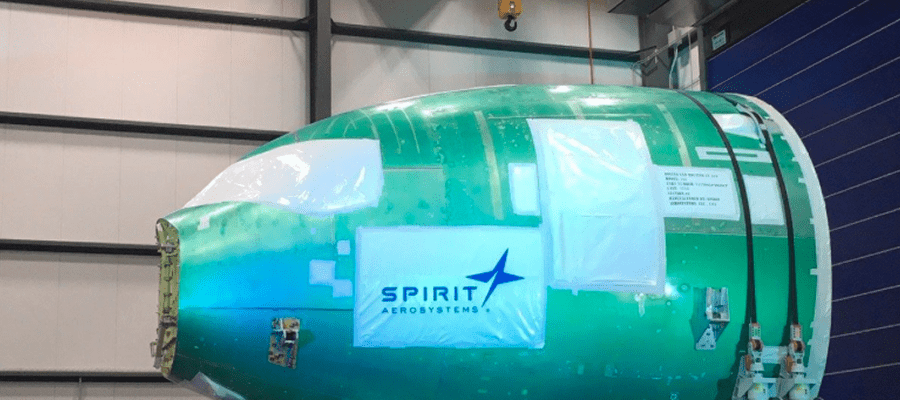
The US Federal Trade Commission (FTC) has ordered Boeing to sell “significant” Spirit AeroSystems assets in order to “resolve antitrust concerns” and close its $4.7bn acquisition of the wing and fuselage manufacturer.
In an order published on Wednesday (December 3), the FTC said Boeing must divest of “key” Spirit businesses that currently supply aerostructures to Airbus, including “all necessary assets and personnel”.
The regulator said the divestments would “resolve” concerns that the acquisition would “give Boeing the ability and incentive to raise the cost or degrade Airbus' access to inputs for its competing aircraft”.
These divestments were largely agreed upon already, with Airbus signing a definitive agreement with Spirit in April 2025 to take over assets in North Carolina, France, Morocco, Wichita, and Belfast. These facilities produce components for its A350, A321, and A220 programmes.
As part of the deal, it was established that Airbus will receive $439 million as a result of having to acquire the loss-making businesses.
Boeing will divest Spirit's aerostructures business in Subang, Malaysia, which currently supplies both Boeing and Airbus. The business will be sold to Composites Technology Research Malaysia, as announced in August this year.
The FTC's order also requires Spirit to continue supplying to Boeing's defence competitors. Additionally, it proposed further regulatory oversight on the merger with the appointment of one monitor from the FTC and another from the US Department of Defense.
Boeing is reacquiring the struggling aerostructures manufacturer after divesting the company in 2005, largely capturing facilities that produce 737 fuselages.
One day prior to the FTC's order, Boeing CFO Jay Malave had said the Spirit acquisition is in its “final strokes” and is likely to close by the end of the year.
“We think that we've satisfied what we need to satisfy and we're just waiting to sign off on that," Malave said at the UBS Global Industrials and Transportation Conference on Tuesday (December 2). "We still expect that to happen before the end of the year."
Malave added that Boeing has immediate plans to improve Spirit's liquidity position once the transaction is closed.
“As far as [Spirit's] debt and our cash balance, including Jeppesen, we expect to pay down about $3bn immediately of the Spirit debt upon close,” he said.
“There's $2bn of high-yield debt that we think we're just going to take out. And then there's about $1bn of bank notes that we want to take out as well. That will leave [Spirit's] legacy debt at around $1bn that we'll retain.”
With the proceeds of its $10.6bn sale of Jeppesen earlier this year, Boeing expects to have a cash balance of $29bn by year-end.