

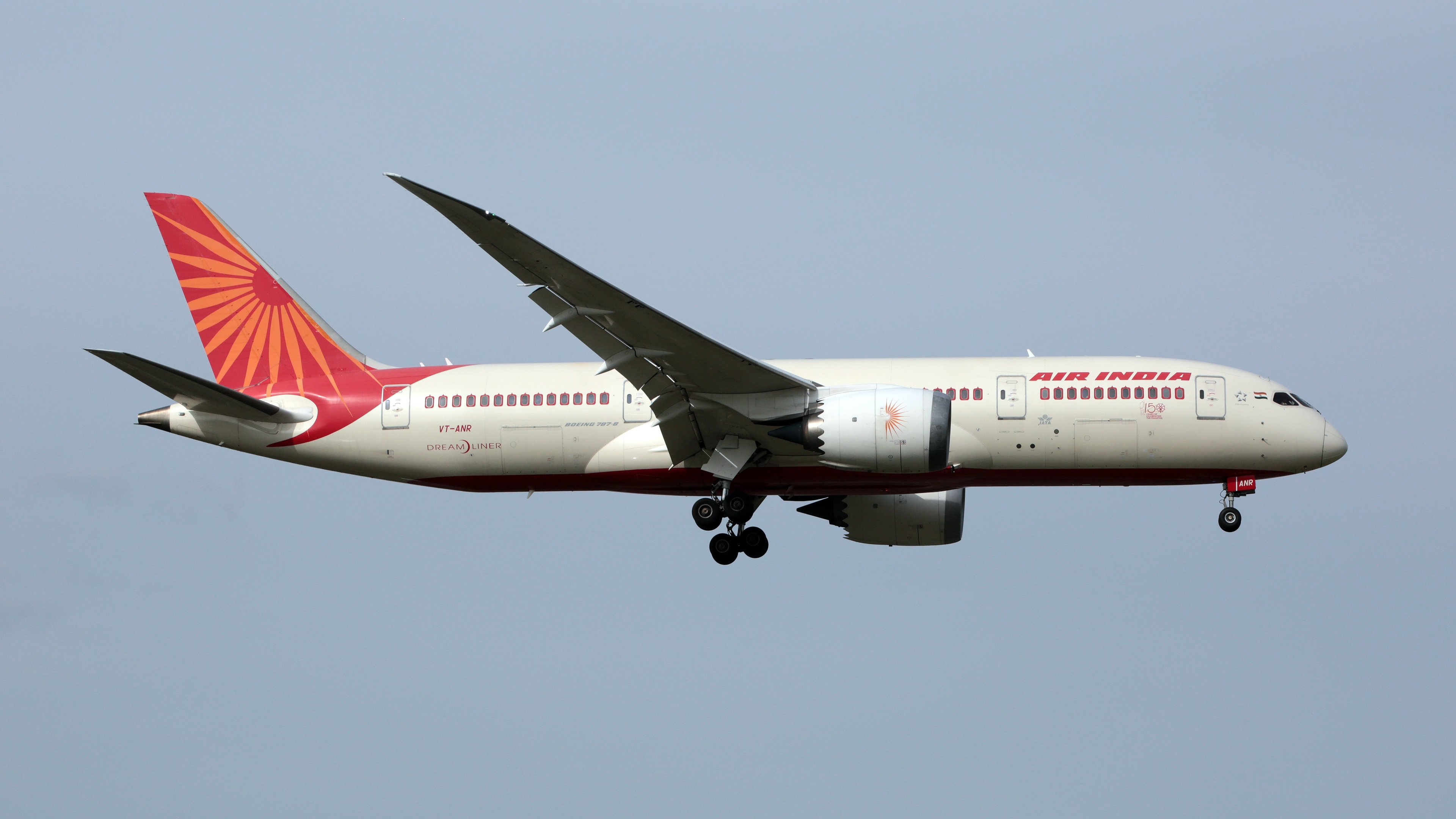
A preliminary report has found that the fuel control switches of Air India flight 171 were suddenly switched to the “cut-off” position, restricting the flow of fuel to both engines and triggering a total loss of power.
India’s Aircraft Accident Investigation Bureau (AAIB) stated that cockpit voice recording data shows one of Flight 171's pilots asking the other, "Why did he cut off?" The other pilot responded that he did not.
The report found that fuel switches to the engines transitioned from the “run” to cut-off position one after another, with a time gap of one second in between.
The flight, which was operated by a 12-year-old 787-8 aircraft, was carrying 242 passengers and crew when it departed from Ahmedabad in western India on June 12, 2025, bound for London's Gatwick Airport. On board were 169 Indian nationals, 53 British nationals, one Canadian national and seven Portuguese nationals.
The report detailed that in December 2018, the US Federal Aviation Administration (FAA) issued a notice about a potential issue with the fuel control switch locking feature on Boeing’s 737 aircraft. Some operators reported that these switches were installed without the locking feature engaged. However, the FAA did not consider this issue serious enough to require a mandatory fix.
The design of this fuel control switch, including the locking feature, is similar across various Boeing models, including the 787-8 aircraft. Air India did not perform the suggested inspections because the bulletin was advisory, not mandatory.
Maintenance records show that the throttle control module on the aircraft involved in this incident was replaced in 2019 and 2023, but these replacements were not related to the fuel control switch. Since 2023, there have been no reported issues with the fuel control switch on this aircraft.
Data shows that after the aircraft achieved a maximum recorded airspeed of 180 knots, the core deceleration of engine one stopped, before beginning to recover. The second engine restarted but couldn't stop its core speed from slowing down. It had to repeatedly add fuel to try and speed up and recover.
As the aircraft was losing altitude, the aircraft initially made contact with several trees and an incineration chimney inside an army compound before impacting a building. The distance between the tree on which the aircraft made its initial contact and the point of where the aircraft impacted was 293 feet.
Last signal from the aircraft was when it was at 625 feet, with a ground speed of 174 knots. The plane then started to descend with a vertical speed of -475 feet per minute, Flightradr24 data shows.
The wreckage was spread over an area of approximately 1,000 feet by 400 feet, from the first impact point to the last identified piece of the aircraft.
In addition to the fuel control switches, investigators found that the flap handle assembly, which was badly damaged by heat following the crash, was set in the five-degree flap position, which is normal for takeoff, and the landing gear lever was in the “down” position at the time of the accident.
New CCTV footage obtained from the airport showed Ram Air Turbine (RAT) getting deployed during the plane’s initial climb immediately after lift-off. No significant bird activity was observed in the vicinity of the flight path, with the aircraft losing altitude before crossing the airport perimeter wall.
“The Air India crash investigation is far from over,” Air India CEO, Campbell Wilson said, adding that the airline continues to cooperate fully with authorities, according to an internal memo seen by Reuters. There was no issue with the quality of fuel or any abnormality in the aircraft’s take-off roll, he noted. The preliminary investigation found no mechanical or maintenance faults with the aircraft or its GE engines.
The report also confirmed that both pilots passed breathalyser tests prior to the aircraft departing.
At this stage of investigation, the AAIB confirmed that there are currently no recommended actions for 787-8 aircraft or GE GEnx-1B engine operators and manufacturers.