
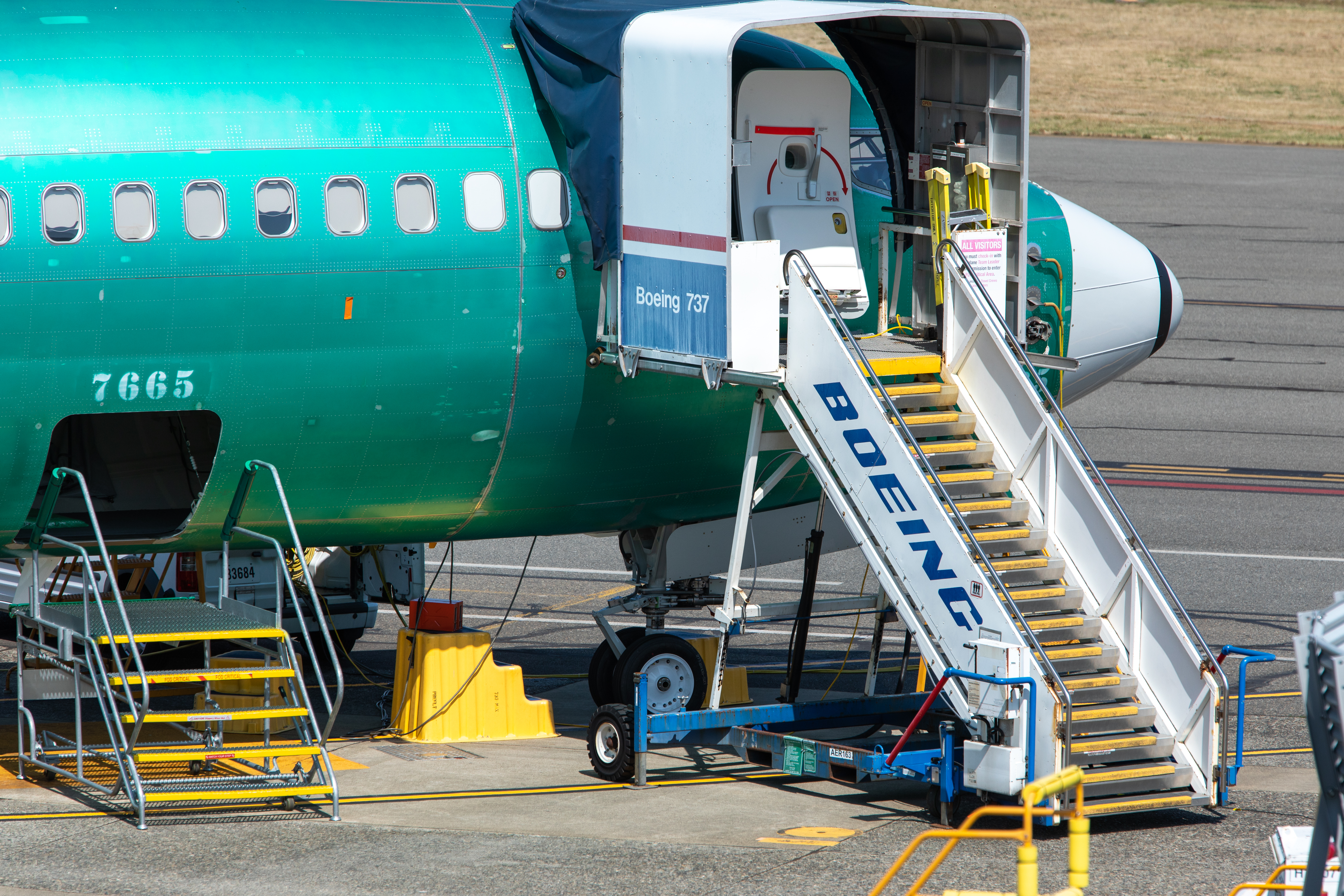
Boeing said that customers in China have indicated that they will not take the delivery of new aircraft from the manufacturer, given current economic uncertainty, as ongoing trade disputes between Beijing and Washington deepen.
Speaking on the company’s first quarter earnings call, Boeing president and CEO Kelly Ortberg stated the manufacturer will take a “very straightforward approach” to dealing with deliveries of aircraft bound for Chinese carriers.
Currently Boeing has 50 aircraft that are due for delivery to Chinese airlines for the remainder of 2025
“We're in close communication with our China customers, and we're actively assessing options for remarketing already built or in process aeroplanes,” Ortberg stated. “For the nine planes not yet in the production system, we're engaged with our customers to understand their intentions for taking deliveries, and if necessary, we have the ability to assign those positions to other customers.”
Both Malaysia Airlines and Air India are reportedly seeking to take aircraft that have been returned by Chinese customers.
In the last week, two Boeing aircraft have been returned from the manufacturer’s 737 completion and delivery centre in China, located in Zhoushan, which is a joint venture with the Commercial Aircraft Corporation of China (COMAC). At the facility, 737 MAX aircraft are fitted with interiors and have airline liveries for Chinese customers sprayed.
Data from AirNav Radar shows that two Boeing aircraft departed from the completion centre.
A spokesperson for Xiamen Airlines reportedly confirmed that the two planes were marked for the carrier and have travelled to the US.
This is the latest development in the ongoing trade war between the US and China, which was triggered on April 2, 2025, after US President Donald Trump initiated sweeping global tariffs on economies around the world. China remains the only country currently facing US tariffs, following President Trump’s 90-day tariff freeze on other countries. In response to Washington’s 145% tariffs on Chinese imports, Beijing raised its own levies on US goods to 125%.
The Boeing chief also signalled that the company has many customers who want near term deliveries, with plans to redirect the supply to “stable demand”. “We're not going to continue to build aircraft customers who will not take them,” Ortberg added.
Currently 80% of Boeing’s deliveries this year are for customers outside of the US, with China accounting for 10% of its commercial backlog,
When asked about contact with Washington over tariff implications, Ortberg stated that a day “does not go by” where we are not engaged with someone from the Trump administration on this topic. He added that these conversations have taken place with various cabinet secretaries and with the president himself.
Boeing stated the company is spending “a lot of time” to make sure the administration understands the impact of tariffs on the aviation industry in the US and that they understand how important the industry is to the US economy.
In addition to the impact of tariffs, the company stated that they still expect to deliver in the region of 400 737 MAX aircraft for the year, based on a strong start to the year. Boeing CFO Brian West indicated on the first quarter earnings call that “this should allow us to offset most of any delivery pressure that would come from 25 planes that are already built and are in inventory and around six that are in production.”
Boeing said it expects second-quarter deliveries of its MAX aircraft to be broadly in line with the first quarter, excluding aircraft bound for China, with April deliveries projected in the "high 20s." The company’s CFO stated that Boeing has already delivered five aircraft during April.
Boeing is also set to ramp up 787 production, to a rate of seven aircraft per month, despite some deliveries to China potentially being delayed. The company emphasised that delivery timing issues would not impact its planned production rate increases.
When looking ahead towards the end of the year and into 2026, Ortberg stated that he expects 737 production to ramp up past 38 aircraft per month.
Focusing on stability, Boeing said an initial rate increase will take place from 38 to 42 aircraft per month. After that, the company will scale up in increments of five per month, moving from 42 to 47, and then from 47 to 52. Each of these increases would likely occur no sooner than six months apart, Ortberg confirmed.
During the first quarter of the year, Boeing reported a smaller than expected loss after an increase in aircraft deliveries, following what was a turbulent 2024 for the US manufacturer.
"Our company is moving in the right direction as we start to see improved operational performance across our businesses from our ongoing focus on safety and quality," commented Ortberg.
Boeing reported first-quarter revenue totalling $19.5bn, an 18% increase from $16.6bn that was recorded in the same period last year, driven by higher commercial aircraft deliveries and improved performance across its business segments.
The company posted an operating profit of $461 million, compared to a loss of $86 million in same quarter of 2024. Operating margin improved to 2.4%, up from -0.5% a year earlier.
Net loss significantly narrowed to $31 million, down from $355 million in the year prior. Basic loss per share was $0.16, compared to a loss of $0.56 per share during the first three-month period of 2024.
Core operating earnings came in at $199 million, compared to a loss of $388 million in the same quarter last year. Core operating margin improved to 1% from -2.3%, while core loss per share was $0.49, compared to $1.13 a year earlier.
Despite the earnings improvement, Boeing reported negative operating cash flow of $1.6bn for the quarter. However, this represents an improvement from the same quarter of the year prior.
Commercial Airplanes first quarter revenue totalled $8.1bn. The 777X program began expanded FAA certification flight testing in the quarter, and the company still anticipates first delivery of the 777-9 in 2026.
Commercial Airplanes booked 221 net orders in the quarter, including 20 777-9 and 20 787-10 airplanes for Korean Air and 50 737-8 airplanes for BOC Aviation. The Commercial Airplanes division delivered 130 airplanes during the quarter and backlog included over 5,600 airplanes valued at $460bn.
Boeing has also confirmed that it has entered into a definitive agreement to sell portions of its digital aviation solutions business - including its Jeppesen, ForeFlight, AerData and OzRunways assets - to Thoma Bravo in an all-cash transaction valued at $10.55bn. West noted that the company expects net proceeds of this sale to be in the region of $10bn.
The company’s shares rose 5% in pre-market trading on April 23, 2025, after these results were released.