

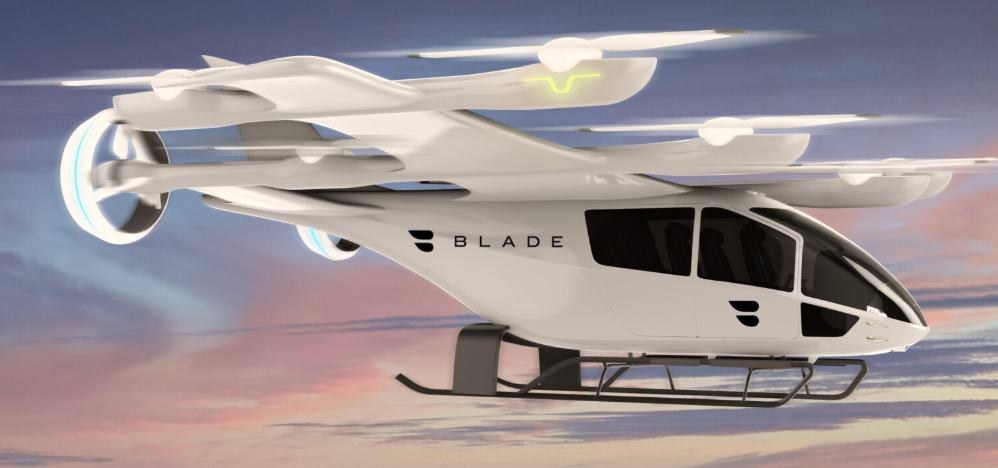
Blade Air Mobility has sold its passenger division to Joby Aviation for up to $125 million. Following the close of the transaction, the company will transition to focus on its medical services and logistics business.
The medical divison will rebrand as Strata Critical Mission after the transaction's close. The company's operating business in the medical segment, which air transports human organs for transplant in the US, will remain Strata's wholly owned subsidiary.
The divestiture of its passenger business includes operations in the US and Europe, lounges and terminals in key hubs, as well as the Blade brand. Operations will continue with the business functioning as a standalone entity within Joby upon closing.
As part of this transaction, Strata will gain access to Joby aircraft for medical use as part of a long-term eVTOL partnership between the companies.
“It is expected that the quiet capabilities of Joby’s aircraft, coupled with its potential to operate at lower costs than traditional helicopters and other shorter-range aircraft, will provide value to Strata customers and a competitive advantage for the company,” the company read in a statement.
The financial impact of the divestiture is expected to be adjusted EBITDA and free cash flow neutral, supported by around $7 million in estimated annual corporate cost efficiencies.
At the closing of the transaction, Rob Wiesenthal, founder and CEO of Blade, will join Joby as CEO of Blade Air Mobility and will also serve as chairman of the board of Strata.
Will Heyburn, Blade’s CFO, and Melissa Tomkiel, Blade’s president and general counsel, will succeed Wiesenthal, serving as co-CEOs of Strata while retaining their CFO and general counsel roles, respectively. Blade's current chairman, Eric Affeldt, will be named lead independent director.
“Blade’s mission since inception has been to accelerate the transition from traditional rotorcraft to electric aircraft,” said Wiesenthal. "There is no stronger company than Joby to help make this mission a reality, for the benefit of all our stakeholders, including our fliers, employees, partners, and the cities we serve."
The transaction is expected to close in the coming weeks with a new ticker for Strata expected to be announced at a later date.
In addition, Blade reported its second quarter results. The company narrowed its second quarter losses and secured revenue growth, driven by continued strength in its medical segment.
Total revenue for the quarter rose to $70.8 million, up 4.2% from $67.9 million recorded a year prior. Revenue for the first six months of the year climbed 4.7% to $125.1 million from $119.5 million that was posted during the first half of 2024.
Cost of revenue increased by 2.9% to $53.1 million, while operating expenses fell 5.4% to $75.8 million, this was due to declines in general and administrative and marketing costs. As a result, loss from operations improved 59.2%, narrowing to $5 million from a $12.1 million loss. Net loss narrowed by 67% to $3.7 million, compared with $11.3 million a year ago.
Gross profit during the quarter rose 13.7% to $12.9 million, lifting gross margin to 18.2%, up from 16.7% a year earlier.
Adjusted EBITDA increased 233% to $3.2 million, up from $1 million, equivalent to 4.5% of revenue. Passenger segment adjusted EBITDA improved by around $1.6 million to $2.4 million, while medical segment adjusted EBITDA rose 9.3% to $6 million.
“This divestiture is transformational for both the Blade passenger business and Blade’s medical division, that will remain a standalone publicly traded company,” said Rob Wiesenthal, Blade's chief executive officer. “We strongly believe that this is the best path forward to create long term value for all stakeholders including employees, customers, partners and shareholders.”
Wiesenthal also noted that Blade’s medical business has grown from 12% of revenue in 2020 to over 60% of revenue over the last year.
Blade closed the quarter with $113.4 million in cash and short-term investments.
The company also reaffirmed its 2025 guidance for full-year revenue of $245 million to $265 million and double-digit adjusted EBITDA.