

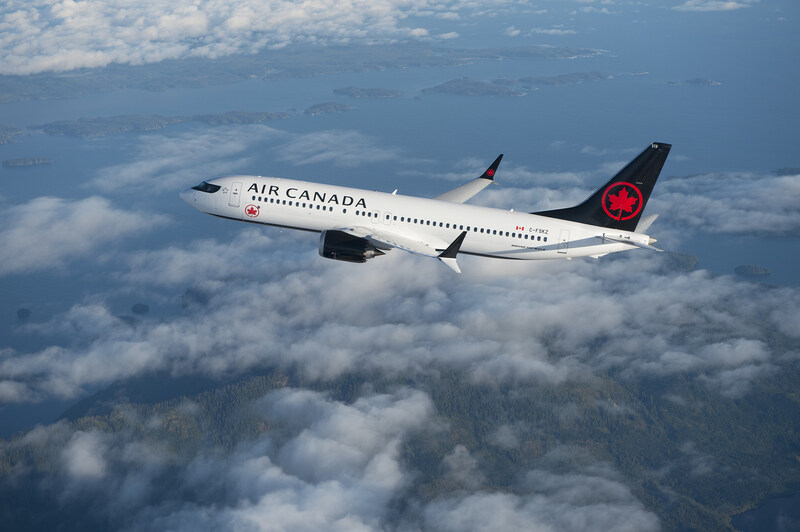
Air Canada posted disappointing results for the first quarter of the year amid economic uncertainty for the industry.
The airline’s revenues dropped C$30 million ($21.5 million) to C$5.2bn ($3.7bn) in the first quarter of the year, compared to the same period last year. The airline reported an operating loss of C$108 million ($73.9 million), swinging from an operating profit of C$11 million ($7.9 million) a year prior. Operating margin fell 2.3 percentage points to a negative 2.1%.
“Our first quarter 2025 results show Air Canada is effectively managing through a turbulent period,” said Air Canada president and CEO Michael Rousseau in a statement.
Net losses widened by C$21 million ($15.1 million) to C$102 million ($73.2 million) during the quarter. Adjusted EBITDA fell C$66 million ($47.4 million) to C$387 million ($277.8 million).
During the company’s earnings call, Rousseau said: “Uncertainty was for sure the main theme of the first quarter related to both the impact of tariffs and the broader economic environment. Furthermore, we noted a decline in interest amongst Canadian to travel to the US.
“The noise around tariffs and trade disputes definitely had an impact. But also, we believe some travellers avoided the US simply because it was expensive with the Canadian dollar trading at levels not seen since 2020.”
He said the impact “remains contained” with it experiencing declines in the transborder markets in the low teens on average over the next six months. The chief executive, however, highlighted the company’s more “diversified network” compared to other network carriers, allowing for overall booking trends to remain stable.
As a result, the airline trimmed its full year guidance. Adjusted EBITDA for 2025 is now expected to be C$3.2bn ($2.3bn) to C$3.6bn ($2.4bn), down from C$3.4bn ($2.4bn) to C$3.8bn ($2.7bn). Additionally, capacity is expected to increase 1-3%, down from 3-5%.
Air Canada CFO John Di Bert said during the call that its first A321XLR has been delayed by a few months, now expected to arrive in 2026. In addition, the 787-10 deliveries are also delayed with the first two to now be delivered in 2026.
“We are working with our partners to mitigate impacts of the OEM deliveries delayed,” he said in the call. He added: “We've been waiting for these aircraft. We're ready to deploy them, and we'll be bringing them in in 2026 and we plan for the CAPEX, so we're managing the business around those parameters, and we have been for now probably a couple years in anticipation.”
For 2025, the company expects to receive 8 A320s. The company received a 737 MAX aircraft, bringing its operating fleet to 46 aircraft.
For the second quarter, Air Canada expects to increase capacity by around 2% and 2.5% from the same quarter in 2024.
Capacity during the first quarter was relatively flat, down 0.4%, while passenger load factor was down 2.3 percentage points to 82%.
Air Canada generated a free cash flow of C$831 million ($596.4 million) during the first quarter, decreasing C$225 million ($161.5 million) compared to the first quarter last year.
In conjunction with its earnings release, Air Canada said it intends to purchase for cancellation up to C$500 million ($358.9 million) of its class A and class B shares. The pricing and terms are expected to be determined next week, with the offer completed by the end of June. The substantial issuer bid is expected to be funded with cash.
As of the end of the first quarter, the company’s total liquidity was down C$9.5bn ($6.8bn). Net debt was C$4.7bn ($6.8bn) at the end of the period.