

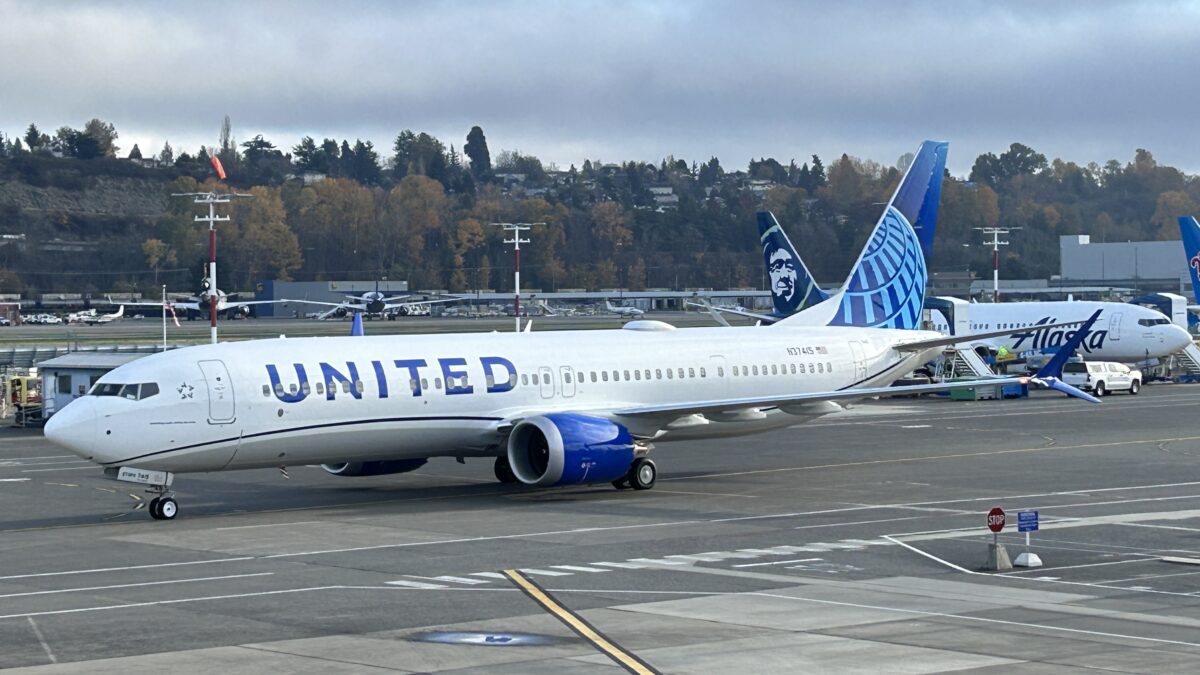
United Airlines chief executive Scott Kirby apparently floated the idea of a merger with American Airlines to senior US officials, according to Bloomberg, in what would amount to the most audacious airline tie-up proposed in US history.
However, the idea immediately runs into a barrage of issues around competition, airport concentration and consumer harm. Reuters later reported that Kirby raised the prospect of a tie-up in a late-February meeting with US President Donald Trump, though there is no indication that formal merger talks are under way and both airlines have declined to comment.
The scale alone would make the transaction extraordinary. United and American are already among the world’s two largest airlines by capacity; controlling over a third of the US market and a merger would create the largest airline in the world. American ended 2025 with a mainline fleet of 1,013 aircraft, while United describes its mainline fleet as already above 1,000 aircraft and still growing under its United Next plan. Even before accounting for regional fleets, a combined airline would therefore start with more than 2,000 mainline aircraft.
Regulatory attitudes
This makes the regulatory hurdles very high. Transportation Secretary Sean Duffy said publicly that there is “room for some mergers” in US aviation, potentially suggesting a greater openness to consolidation, but he also stressed that any deal would be judged on its effect on competition, consumer pricing and the industry’s global position. Duffy has specifically warned that mergers involving larger airlines might have to divest assets, underscoring the likely need for slot, gate or other carve-outs if a United-American combination ever moved beyond the talking stage.
In the case of a United-American combination, those remedies would almost certainly have to be substantial. In Chicago, where United and American have been engaged in an increasingly bitter competitive battle. United operates roughly half of all scheduled flights at O’Hare, compared with about a third for American, based on Cirium data. Any combination of the two would therefore produce a dominant position at one of the country’s most important hubs and likely force disposals of gates, slots or schedules. Duffy’s own remarks about “peeling off” assets appear aimed at precisely this kind of concentration problem.
Los Angeles would raise similar issues. Kirby has argued such a merger would make a combined airline more competitive internationally, but that rationale would collide with the reality that United and American already have significant overlap in large business markets and international gateways. Consumer groups, rival airlines and labour unions would be expected to scrutinise any claim that a bigger network would outweigh the likely loss of head-to-head competition on domestic and transatlantic routes. Such a deal would probably increase pricing power, a point likely to resonate with regulators after years of concern about fare levels in a highly consolidated US market.
Individual US states along with consumer groups could also wade into the debate with lawsuits further complicating any attempt at merging the two airlines.
A history of consolidation
Nonetheless, the US has been through several rounds of consolidation creating four dominant carriers - American, Delta, United and Southwest - controlling about 80% of the domestic market. The landmark deals included American’s acquisition of TWA in 2001, Delta’s purchase of Northwest in 2008, United’s merger with Continental in 2010, Southwest’s acquisition of AirTran in 2011 and American’s merger with US Airways in 2013. Under traditional anti-trust considerations, such as market share, it would be highly unlikely for such a merger to be allowed to happen, especially as the US airline market is arguably not fragmented.
Recent precedent also runs against the idea that size alone will be tolerated. In January 2024, a federal judge blocked JetBlue’s proposed $3.8 billion acquisition of Spirit Airlines on competition grounds, and the two carriers abandoned the deal two months later. The ruling turned on concerns that the merger would limit competition and harm consumers. If that was enough to stop a tie-up between two smaller players, a transaction combining two of the largest network carriers in the country would face scrutiny on an entirely different order.
Kirby’s motives are clear. He told employees last month that United would benefit from any shakeout caused by higher oil and fuel prices, potentially creating opportunities to buy assets. In a Bloomberg Television interview in Los Angeles on March 24, he said that if weaker players needed help, United would be there “to pick up some of those assets,” adding, when asked whether that meant buying entire companies, “we’ll see, there’s lots of rumours about that.” Kirby is reported to have framed a United-American combination as a way to strengthen US competitiveness on international routes, where foreign airlines still account for a large share of traffic.
There is also a personal and strategic angle to the idea. Kirby previously served as American’s president but left after it became clear he would not become chief executive there. Since joining United in 2016, he has repeatedly contrasted United’s premium-heavy strategy with what he sees as American’s slower response to the higher-margin demand trends that have benefited United and Delta. The two carriers have also fought publicly and legally over gates and growth at O’Hare airport.
The real angle?
A more cynical reading in airline circles is that floating a merger this large could make any smaller transaction, particularly one involving JetBlue, long seen as a more plausible target for one of the larger airlines, appear less dramatic by comparison. There is no evidence that this is Kirby’s strategy. But the timing matters: Duffy has signalled openness to consolidation, fuel prices have risen sharply because of the Middle East conflict, and market stress has revived merger speculation across the sector. In that environment, even an improbable idea can alter the political baseline for what counts as a “big” deal.
The ramifications of a ‘United-American’ combination may not be that this particular deal happens, it seems likely that it won’t, but rather is that it will fire the starting gun on a series of smaller transactions, such as the takeover of JetBlue, which has effectively placed itself on the market.