

SkyWest reported full-year 2025 net income of $428 million, or $10.35 per diluted share, turning a 15% increase in production (block hours) into a 31% jump in pretax income to $566 million, highlighting what management described as strong operating leverage in its contract-heavy model.
For the fourth quarter, SkyWest posted net income of $91 million ($2.21 per share) on revenue of $1.0 billion, up 8% year-on-year. CFO Rob Simmons said the quarter included a $7 million hit from mandated flight cancellations tied to a government shutdown, equivalent to $0.13 per share, after SkyWest cancelled roughly 2,000 flights and 3,000 block hours. EBITDA for 2025 was $982 million, up more than $100 million versus 2024, while free cash flow topped $400 million.
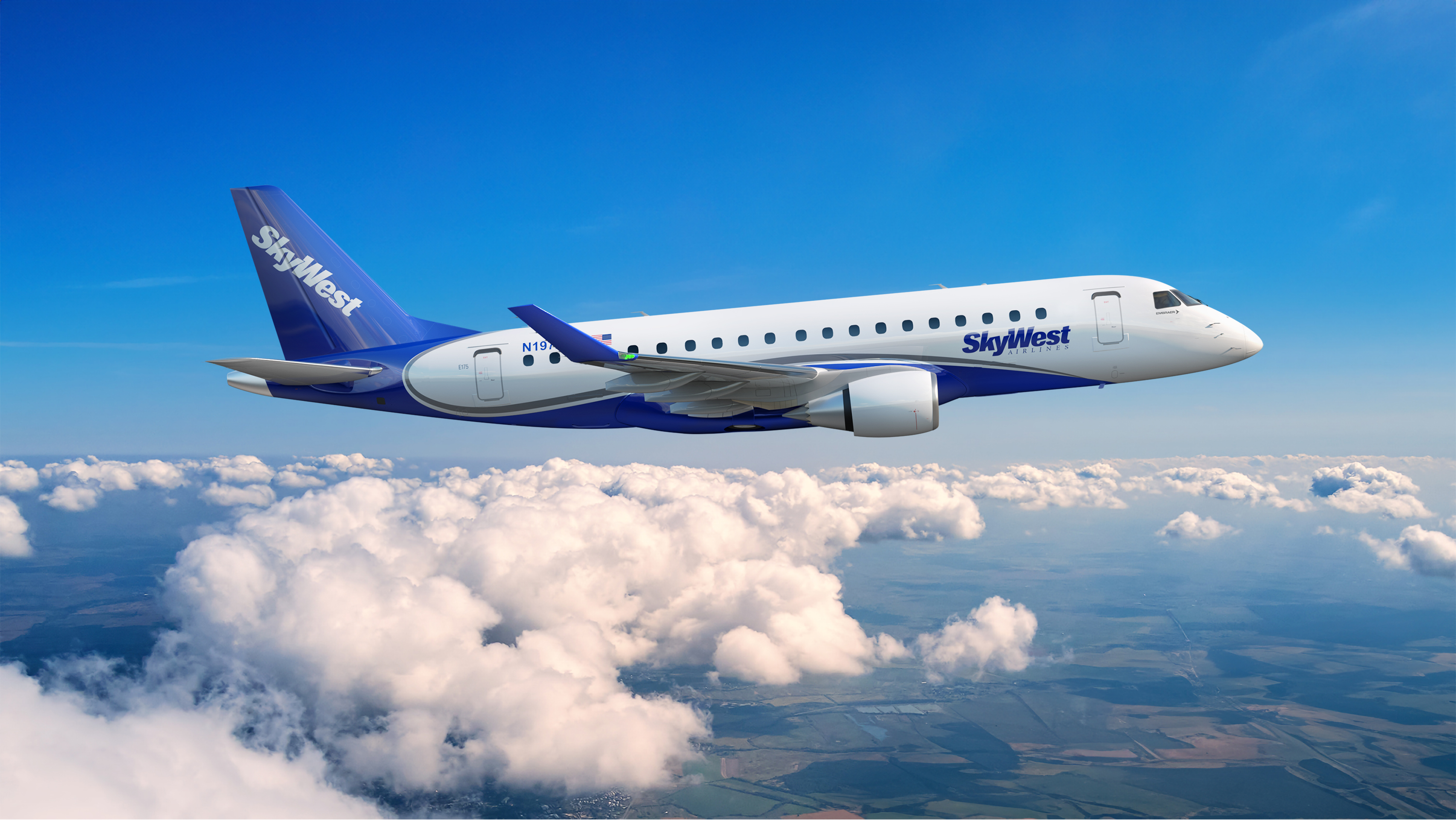
On an earnings call, SkyWest management emphasised new multi-year contract extensions covering 40 Embraer E175s with United Airlines and 13 E175s with Delta Air Lines, leaving SkyWest with no major E175 contract expirations until the back half of 2028. Chief commercial officer Wade Steel said the carrier took delivery of five new E175s for United during the quarter and financed seven new E175s during 2025.
SkyWest ended 2025 with 69 E175s on firm order with Embraer, including allocations for Delta (16), United (8) and Alaska Airlines, with 44 aircraft not yet assigned. Steel said delivery slots run from 2027 through 2032 and the order is structured with flexibility to defer or terminate aircraft if partner placements are not secured. The company reiterated its plan to reach nearly 300 E175s by end-2028, maintaining its position as the world’s largest E175 operator.
Alongside E175 growth, SkyWest continues to lean on CRJ fleet optionality. Steel said the company expects the remaining 23 aircraft in its 50-aircraft CRJ550 agreement with United to enter service later in 2026 (27 were in service at year-end). SkyWest also previously agreed to extend up to 40 CRJ200s with United into the 2030s.
SkyWest expects around 20 parked dual-class CRJs to return to service as they complete heavy maintenance, with signed contracts already in place for many of them. The carrier also has more than 40 parked CRJ200s, which management said adds flexibility as it evaluates market opportunities. Offsetting some of the uplift, SkyWest expects to return roughly 19 Delta-owned CRJ900s to Delta over the next couple of years, though Steel said that return is now expected to occur more slowly than previously anticipated.
SkyWest repaid $492 million of debt in 2025, ending the year with $2.4bn of total debt versus $2.7bn a year earlier, despite financing aircraft deliveries. Cash at year-end was $707 million. The company also stepped up share repurchases, spending $85 million in 2025 to buy nearly 850,000 shares, with $213 million remaining under its current authorisation.
Simmons said SkyWest has roughly $1.5bn of unencumbered equipment, providing additional financing flexibility. Capital expenditures were about $580 million in 2025, and the company expects $600–$625 million in 2026, driven by a planned nine new E175 deliveries.
Management described “extremely strong” demand for its prorate product and outlined plans to redeploy aircraft to underserved communities as utilization improves. SkyWest also disclosed it has begun a prorate agreement with American Airlines, currently operating four aircraft with up to nine expected by mid-2026.
On the cost and reliability side, SkyWest flagged ongoing constraints in third-party MRO capacity –particularly labour and parts availability – expecting 2026 maintenance expense to remain broadly consistent with 2025 as it brings aircraft out of long-term storage. Executives also pointed to improving operational performance, including more than 250 days of “100% controllable completion” in 2025, and highlighted the company’s inclusion in Fortune World's Most Admired Companies for 2026.
For 2026, the company guided to mid-single-digit block-hour growth and provided earnings colour of “mid-$11” per share, with a return to sharper, pre-COVID-like seasonality – flat to down in Q1 versus Q4, with Q2 and Q3 expected to be the strongest quarters.