

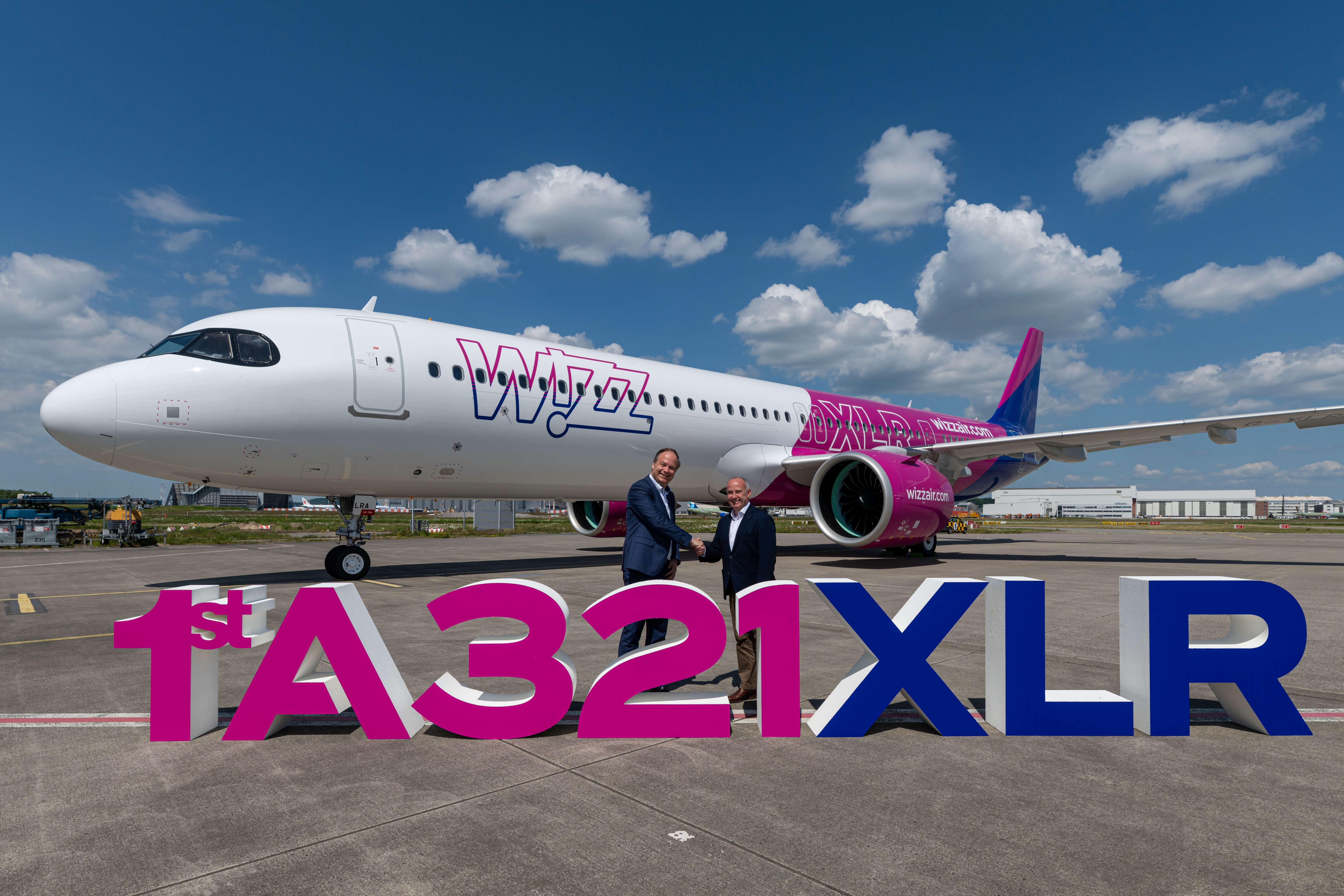
Wizz Air is reducing 47 A321XLR on order by 10 to 15 aircraft in an effort to “right size” its fleet, the company said during its first fiscal quarter earnings on July 24, 2025.
This comes shortly after the company pulled out of its Abu Dhabi subsidiary – a joint venture with the country’s state-owned Abu Dhabi Development Holding Company – earlier this month. Management said it had already moved two aircraft out of the subsidiary back into Europe with two more on the way. There will then be eight A320CEO family aircraft left to be brought out. Management said in the call: “We're still trying to figure out what exactly the plan is, but they will be certainly parked for a while.”
The company said it will convert these XLRs as opposed to cancelling, as well as continuing to retire as many A320CEO family aircraft “as feasible”.
“It’s a good thing because that eliminates – or minimises – some complexities going forward,” said Wizz Air CEO Joszef Varadi.
He said the company was currently in discussions with Airbus and would “shortly” be sharing the timings and terms for each asset. The company had noted that hot and harsh environment of the Abu Dhabi region, coupled with geopolitical tensions and geared turbofan (GTF) engine issues.
“You could argue that if we had only one of these issues, maybe we could overcame that one,” Varadi said. “But the three issues combined, on a cumulative basis, basically just reached critical mass versus the level of tolerance.”
The company said it had 41 aircraft on ground (AOG) as a result of the engines issues at the end of the quarter, down from 46 at the same time last year. The company said its spare engine acquisition strategy will help it lift its grounded fleet.
Varadi continued: “In regards to target markets for the XLR, we don’t have plans for transatlantic. You should not be expecting us to fly over the Atlantic from the UK. The XLR will continue to create a hot and harsh exposure, but a lot more limited than what we are having at the moment.”
He pointed to various high demand countries that are considered hot and harsh such as Cyprus, Morocco, Israel.
“Hot and harsh is not an issue for demand,” said Varadi. “The challenge here is how do you contain that exposure more than what we are at this time? Our objective isn’t to completely eliminate hot and harsh – we would be really cutting into key customer demand otherwise.”
Target marks for the XLR will remain Middle East and parts of Africa.
With the company returning to Tel Aviv next month, management during the call said that it was “probably not” a risk business-wise to return. “From a safety and security perspective, we feel confident and comfortable with the decision we are taking,” Varadi said in the call. “Given our stake in Israel… we’ll be seeing that this has been the right decision.”
Wizz said its fiscal year's second quarter RASK is expected to be flat, driven by the reduction of its Tel Aviv operations and some “consumer price resistance”. The company added that first half capacity will be impacted by network design and route rationalisation.
Second quarter capacity is expected to be up high single digits, with load factor flat. Unit costs are expected to be down high single digits. Excluding fuel, unit costs are expected to improve versus the first quarter.
The company did not provide a full year guidance.
The company reported a first fiscal quarter net profit of €38.4 million, soaring from €1.2 million, though operating profit dropped 38.3% to €27.5 million. The company's total revenue climbed 13.4% to €1.4bn, unit revenue up 2.1% to 4.41 cents. Unit costs were down 14.2% to 1.35 cents, while unit costs excluding fuel climbed 14.2% to 3.11 cents.
Capacity was up 11% and load factor was flat at 91.1%.
As of the end of the quarter, cash totalled €2bn, and net debt was €4.7bn.