

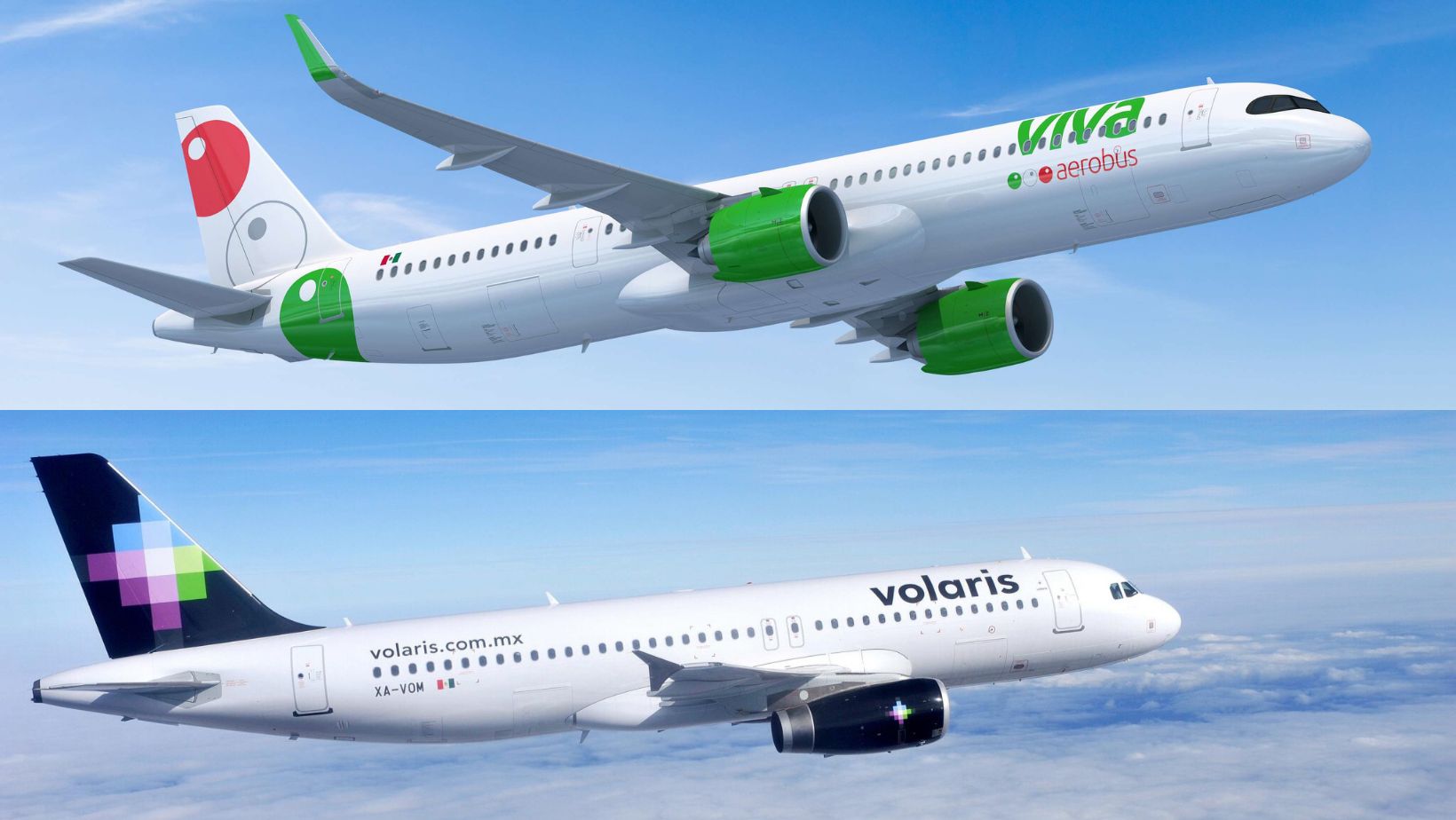
Volaris and Viva Aerobus have struck a merger agreement, the companies said yesterday (December 18).
Both carriers will keep their operations separate under their own operating certificates and retain their own brands.
The agreement will see the formation of "a new Mexican airline group under a holding company structure" that aims to expand its low-cost carrier model and point-to-point travel to more cities in Mexico and internationally.
“Our two airlines have highly complementary networks,” said Volaris president and CEO Enrique Beltranena. "Volaris has a presence along the Pacific corridor and in key western and central markets. Viva is positioned in the east, including Monterrey, the Gulf region and the Felipe Angeles airport.
“Together, this complementary footprint creates a unique opportunity to enhance our reach, continue to expand the market and advance the democratization of aviation.”
“The transaction is expected to deliver significant benefits to both Volaris and Viva’s employees, passengers, communities, suppliers, and shareholders," said Volaris in a statement. "Simultaneously, the new group will support investments, jobs, air connectivity, tourism, and economic development across Mexico.”
“We expect the formation of this new airline group will mark an opportunity to realize significant long-term growth for airline travel in Mexico, in line with the low-fare and point-to-point approach that has revolutionized the industry over the last two decades,” said Beltranena.
“Both airlines share a similar low-cost DNA and mindset and have always believed in making travel more accessible and possible for everyone,” said Viva CEO Juan Carlos Zuazua. "Our passengers choose us for our point-to-point networks, seamless customer service, and low fares, so maintaining our ultra-low-cost strategy is essential for sustaining growth.”
Both carriers launched their inaugural flights nearly 20 years ago, in 2006.
“Since our founding 20 years ago, both airlines have shared a similar vision and purpose of making flying possible for all,” said Zuazua. “Air travel in Mexico has nearly tripled since Viva and Volaris introduced ultra-low fares in the country, reaching 120 million passengers in 2024.”
“We know Mexico can go further,” said Beltranena. “The market here still lags in flights per capita compared to emerging economies such as Colombia and Chile and the rest of North America. With this new airline group, we can close the distance.”
Both carriers will benefit from lowered fleet ownership costs, improved access to capital, and strengthened financial position.
“The airline group will provide financial stability from a more robust balance sheet with better capitalisation, strong liquidity and a solid leverage profile with combined net debt to EBITDA of 2.7x,” said Beltranena during a conference call today.
Beltranena added: “Joint procurement will also help our airlines more effectively and efficiently navigate ongoing fleet supply and OEM disruptions.”
Under the agreement, Viva and Volaris shareholders will combine their holding companies through a merger of equals. Upon closing, Viva shareholders will receive newly issued shares of the Volaris Holding Company, and Volaris shareholders will continue to hold their shares. Each shareholder group will own 50% of the new group on a fully diluted basis.
Beltranena said with Volaris bringing the larger platform consistent with its fleet and revenue, it is “reasonable to view Volaris as contributing 60% of enterprise value, with Viva contributing around 40%”.
“Ownership should, however, be evaluated on equity value, not enterprise value alone,” he said. “Volaris carries a relatively higher net debt load.”
As of the end of the third quarter, Volaris had a net debt of $3.1bn and Viva had $1.9bn.
Beltranena continued: “When you bridge from enterprise value to equity value, the relative equity contributions become relatively much closer… both shareholder bases will share equally in the upside and that upside comes from the value unlocked by larger operating scales going forward.”
The board of directors of both Volaris and Viva have approved the transaction and it now requires regulatory and shareholder approvals. The deal will create “significant shareholder value”, the companies said.
The board of directors will comprise of six members from Volaris and six from Viva, chaired by current Viva chairman Roberto Alcantara Rojas. The existing leadership teams of both airlines will remain in place at each air carrier.
“Volaris and Viva operate with a high degree of compatibility across fleet, airport infrastructure, technology, reservation systems, suppliers, and technical capabilities, driving substantial potential for synergies,” they said.
Both airlines' fleets primarily consist of Airbus A320 aircraft. As of the third quarter, Volaris had 152 A320 family aircraft in its fleet, while Viva had 99 A320 jets.
Zuazua said during the conference call that Viva has over 100 planes and around 20 are already under finance leases or other structured instruments.
“In the last couple of years, Viva has been moving from operating leases towards finance leases,” he said. “That is one of the huge benefits of this scale. With this group, we're going to be able to access lower cost of capital… and we're going to be able to reduce aircraft ownership costs.”
He explained during the call that aircraft ownership costs make up the largest cost line at around 30-35% for both carriers.
“We have significant potential to reduce those costs over time through disciplined capital allocation,” he said.
With the merger, the group expects to have “optimised unit costs, low leverage, and better access to lower-cost capital”, while pursuing “sustainable growth” facilitated by the lower fleet costs.
The deal is expected to close sometime next year.
Morgan Stanley is serving as financial advisor to Volaris. Latham & Watkins and Mijares, Angoitia, Cortes y Fuentes are serving as legal advisors to Volaris. FTI Consulting is serving as strategic communications advisor to Volaris.
Alfaro, Davila & Scherer and UBS Investment Bank are acting as financial advisors to Viva. Cleary Gottlieb Steen & Hamilton and Ritch, Mueller y Nicolau are serving as legal advisors to Viva.