

JetBlue improved its net losses in the first quarter of 2025, the airline revealed in its financial report published April 29, 2025. The company reported a net loss of $208 million, or 59 cents loss per share, for the first quarter of 2025, improving significantly from its net loss of $716 million, or $2.11 loss per share, in the same period a year prior.
Revenues had dropped slightly by 3.1% down to $2.1bn – comprising of $2bn in passenger revenues, down 4.2%. However, total operating expenses dropped 21% to $2.3bn. These cost savings were driven by the company’s JetForward initiative, which aims to rein in costs and secure operational efficiency for the US airline, as well as aiming to deliver $800-900 million in incremental EBIT through 2027.
“We delivered a strong operation and efficiently executed on costs,” said JetBlue CEO Joanna Geraghty. “JetForward is ramping well, and we are focused on successfully managing what we can control. We also acted urgently to manage near-term revenue uncertainty.”
With the current economic uncertainties, the company said it was not reaffirming its prior full year guidance, following its US airline peers. The company maintained, however, around $600 million interest expense for the full year, as well as capital expenditures of around $1.3bn.
JetBlue had made capacity adjustments in the first quarter to meet slipping demand in the US.
“In the first quarter we saw booking strength from January deteriorate into February and worsen into March,” said JetBlue president Marty St. George. “We expect softened demand for off-peak travel to continue into the second quarter, where the booking curve is more exposed to macro uncertainty and deteriorating consumer confidence.”
As a result of this, JetBlue has cut capacity for the second quarter, expected to be down 0.5-3.5% compared to the second quarter last year.
Geraghty added: “As we continue to monitor the evolving macro backdrop, we are evaluating all levers available to us to boost profitability and preserve cash, including additional capacity reductions, targeted cost savings, and further evaluation of our fleet retirement schedule.”
Revenue per available seat mile (RASM) is expected to be down 3.5-7.5% year-over-year in the second quarter, while unit costs excluding fuel are forecast to be up 6.5-8.5%. Fuel costs are estimated to be between $2.25 and $2.40 per gallon. Additionally, capital expenditures for the second quarter are expected to around $400 million in the period.
JetBlue’s chief financial officer Ursula Hurley said the company is “confident” its JetForward strategy will put it on the path to sustained profitability, adding the progress made in the first quarter was “encouraging”.
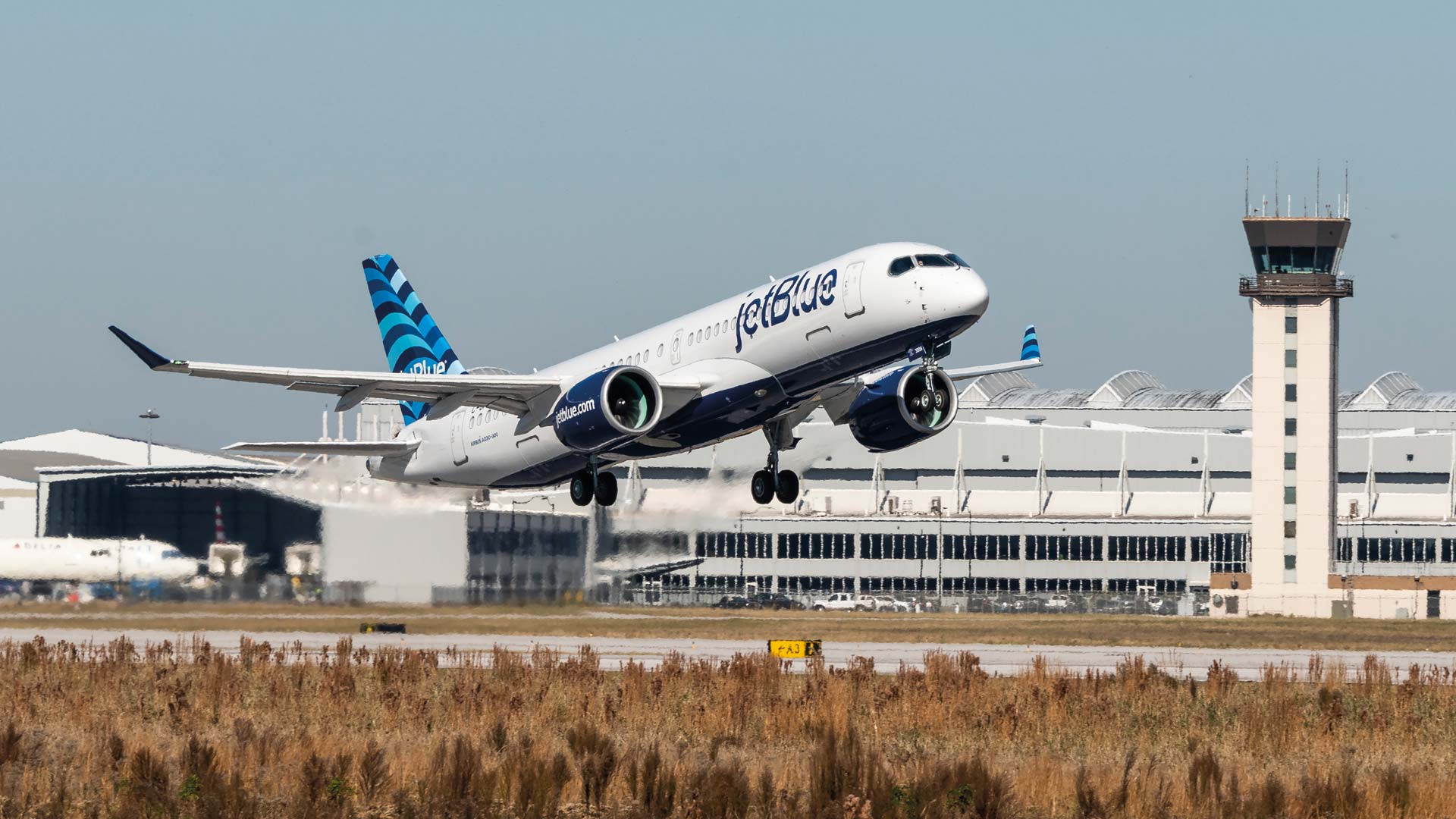
The company added in an investor update that its previously disclosed plans to remove all 12 of its E190 aircraft from its operating fleet will be completed following the summer peak season this year. The airline will use A220s in their place. As of the end of March, the company is scheduled to receive 18 A220s this year, followed by 16 next year. The company also expects three A321neos this year and one next year. Of the 21 deliveries for 2025, the company has received three so far, which management said were paid for in cash.
During the call, Hurley said: “We do not expect a meaningful tariff impact in 2025 as most of our upcoming aircraft deliveries are assembled in the United States. We continue to evaluate the industry wide tariff exposure outside of aircraft purchases, focussing on spare parts as well as repairs happening abroad. The situation is fluid and we plan to be nimble in responding to the changing environment.”
Management noted during its call that as it pulls down capacity in response to the economic turbulence, the timing of its maintenance expenditure will continue to shift. Management noted that the GTF engines are all on flight hour agreements. With capacity down, the flight hours will “shift to the right” too.
“The second component of the potential maintenance savings is we did anticipate keeping in the fleet 30 A320 aircraft,” said Hurley in the call. “We are revisiting that decision in light of the capacity backdrop. They obviously need a certain level of investment, whether it be interiors or significant maintenance shop visits. Early indications is that we won't do the full 30 and we'll scale back so that will achieve some level of maintenance savings as well.”
Management said in the call that had “seen improvement” from Pratt & Whitney regarding the GTF engines. The company had previously estimated mid- to high-teens aircraft on ground (AOG) in 2025. However, the airline currently has only 10 AOG. JetBlue noted that the GTF engines are staying on wing longer, as well as the supply chain continuing to improve, and turn time for shop visits are also improving, driving the decreased AOG for the airline.
“We're very pleased with the progress that we're seeing,” said management. “Quite frankly, we're getting aircraft back a time when we don't necessarily need capacity. When we do get on the other side of this macro backdrop environment challenges, this will just be a tailwind for JetBlue.”
During the earnings call, George said the company has made “good progress” on discussions regarding a domestic airline partnership. JetBlue expects to announce this partnership some point during the second quarter, with George stating it would “come soon”. This comes after American Airlines said on April 28, 2025, it would be suing the airline for the failed Northeast Alliance (NEA). George clarified the airline was a “domestic airline with a larger network”.
During the first quarter, RASM was 13.71 cents, up 1.3%, while unit costs excluding fuel was up 8.3% to 11.45 cents. Including fuel, unit costs were down 17.4% to 14.83 cents. Additionally, the airline’s load factor averaged at 80.7%, up one percentage point.
As of the end of the period, the company held $2.3bn in cash and cash equivalents. Debt totalled $8.5bn. The company ended the period with $3.8bn of liquidity.