

Emirates Group has delivered a new half-year profit record and a fourth consecutive year of record profitability for the fiscal-year H1 reporting period.
The Group delivered a pre-tax profit of AED 12.2bn (US$ 3.3bn) for the first six months of 2025-26, up 17% from the same period last year. Revenue rose 4% to AED 75.4bn (US$ 20.6bn).
Emirates airline likewise posted a new record half-year pre-tax profit of AED 11.4bn (US$ 3.1bn), up 17% over the same period last year. Revenue rose 6% to AED 65.6bn (US$ 17.9bn).
dnata, Emirates’ aviation services arm, delivered a record pre-tax profit of AED 843 million (US$ 230 million), up 17% compared to the same period last year. It also delivered record half-year revenue of AED 11.7bn (US$ 3.2bn), up 13%.
The Group’s after-tax profit was AED 10.6bn (US$ 2.9bn), up 13% from last year.
Sheikh Ahmed bin Saeed Al Maktoum, chair and CEO of Emirates airline and Group, said the performance reflects “strong and sustained” demand across all regions and growing customer preference for the airline’s premium cabins.
“Global demand for air transport and travel services has been buoyant, despite geopolitical events and economic concerns in some markets,” he said.
“We expect this demand resilience to continue for the rest of 2025-26, and look forward to increasing our capacity to grow revenues, as new A350 aircraft join the Emirates fleet and new facilities come online at dnata.”
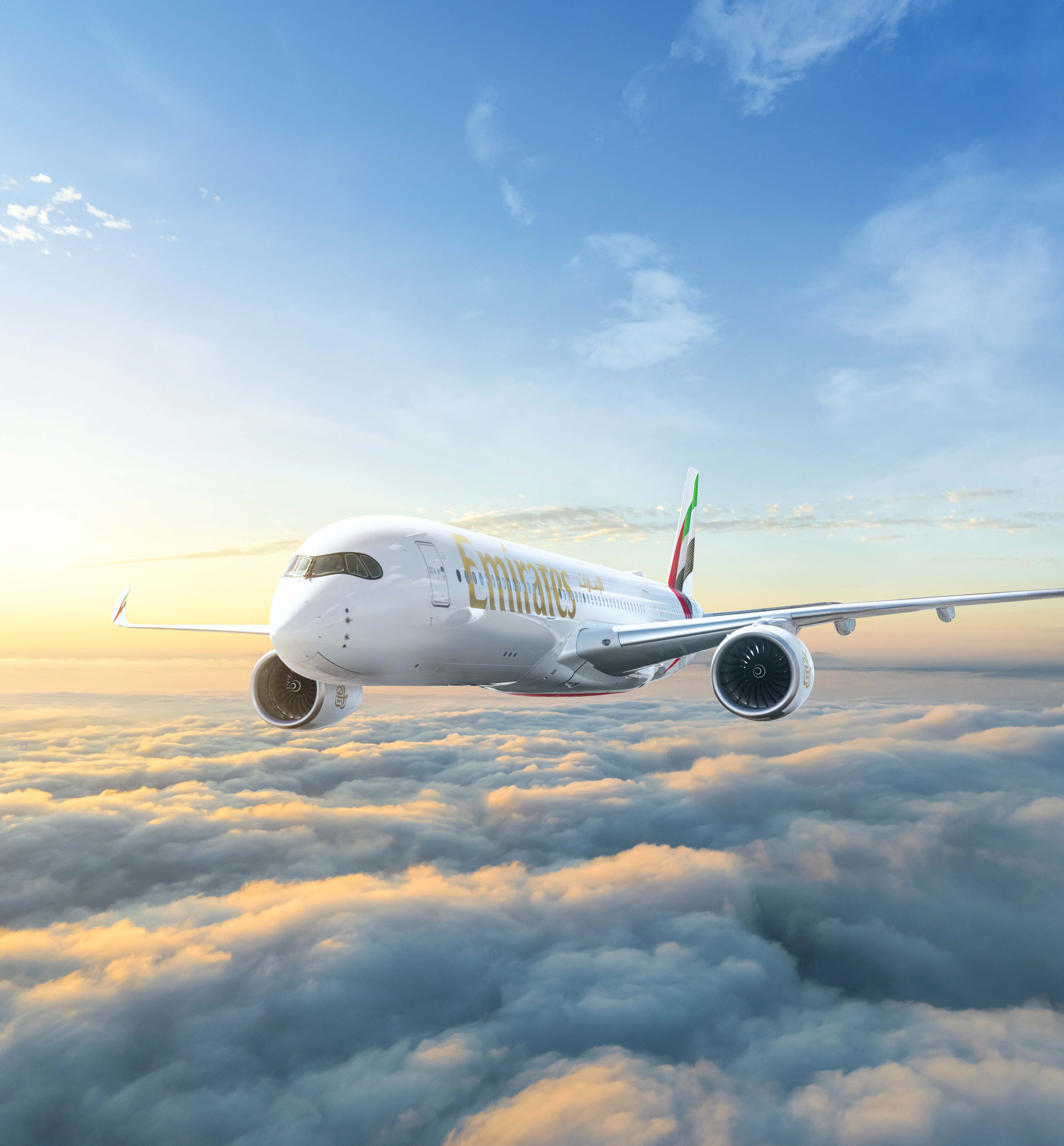
Emirates took delivery of five new A350 aircraft during the fiscal H1, adding more business class and premium economy seats to the airline’s inventory.
During this period, Emirates also completed the retrofit of 23 aircraft (six A380s and 17 Boeing 777s) as part of an ongoing $5bn retrofit programme.
By September 30, 2025, premium economy was available to customers flying between Dubai and 61 cities.
The Group closed the first half of the year with a record cash position of AED 56.0bn (US$ 15.2bn), up from AED 53.4bn (US$ 14.6bn) the prior year.
Emirates has been able to draw on its own cash reserves to support business needs, the company said, including for funding new aircraft deliveries and servicing existing debt obligations.
The Group also paid the remaining AED 2bn (US$ 545 million) in dividends to its owners — of the AED 6bn (US$ 1.6bn) declared during the financial year 2024-25.
Emirates Group’s employee base grew 3% during fiscal H1 to a total of 124,927, and both Emirates and dnata are currently undergoing recruitment drives.
During fiscal H1, Emirates launched new flight services to Danang, Siem Reap, Shenzhen, and Hangzhou.
By the end of the period, Emirates’ passenger and cargo network spanned 153 airports in 81 countries and territories.
The airline also strengthened its network connectivity by deploying 28 additional weekly scheduled flights to Antananarivo, Johannesburg, Muscat, Rome, Riyadh, and Taipei.
Additionally, it entered agreements with three codeshare and interline partners, namely Air Seychelles, Condor, and Aurigny.
Capacity measured in available seat kilometres (ASKM) increased 5% while passenger traffic carried measured in revenue passenger kilometres (RPKM) increased 4%.
Average passenger seat factor was 79.5% compared with 80% during the same period last year.
Emirates carried 27.8 million passengers between April 1 and September 30, 2025, up 4% from the same period last year.
Emirates SkyCargo transported 1.25 million tonnes in the first six months of the year, up 4% compared to the same period last year.
Customer demand for Emirates SkyCargo’s products and network of freighter and bellyhold cargo operations remained steady.
However, cargo yields fell 6% due to softening demand in some market segments amidst tariff concerns.