

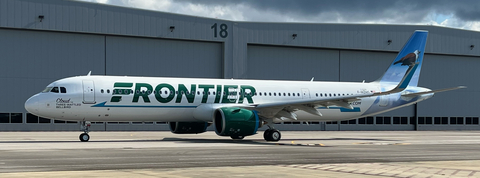
Frontier Airlines swung to a loss in the second quarter of the year as economic uncertainties and domestic air travel market challenges weigh on its results.
“We’ve been burned in the last six months in this industry in the domestic market,” said Frontier Airlines CEO Barry Biffle during the company’s earnings call.
The company reported a net loss of $70 million, down from a net profit of $31 million a year prior. Loss per share was 31 cents, down from earnings of 14 cents per share last year.
“The domestic supply and demand balance is anticipated to improve sequentially over the next several months in Frontier markets,” Biffle said in a statement. He added that this, along with its commercial initiatives, is expected to support its mid-to-high digit unit revenue growth in the third quarter and also “provide a solid foundation for profitability in 2026”.
Frontier guided an adjusted loss per share of 26 cents to 42 cents in the third quarter. This reflects the expected improvement in competitive overlap capacity amongst other initiatives and cost savings. Biffle said while the company was “optimistic” it was still too early to give a more narrowed guidance range.
“I’d love for it to be towards the higher end, but I’ve got to be realistic on recent history,” said Biffle. “When we saw the Gaza and we saw in Israel and there was consumer sentiment and things changed in the middle of June, which corresponded with sales in the month. We've seen it come back, and now it's doing great. We're in a month-to-month consumer sentiment game. But right now, consumer sentiment is good.”
He added optimism stems from not only the returning demand but also seeing the “benefits of the competitive capacity coming out”.
Capacity in the third quarter is expected to be down 4-5% in the quarter.
JP Morgan analysts Jamie Baker and James Kirby said its third quarter guide was “slightly worse than consensus”. They added: “As has been the case for some time, we believe a return to consistent profitability – even inclusive of continued sale leaseback gains – will prove challenging for Frontier, given its current position as the second least-profitable airline in the United States.”
Frontier said it has secured sale leaseback financing commitments for expected deliveries through 2025, and all planned 2026 deliveries through the third quarter of 2026.
Total operating revenues $929 million, down from $973 million. Frontier said this was largely due to the disruption in domestic air travel demand in April, but had “subsequently stabilised during the quarter”, as well as weather and ATC disruptions. Unit revenues were down 2% to 9.01 cents.
Operating expenses climbed from $948 million to $1bn. This comprised of $230 million of fuel expense at an average cost of $2.36 per gallon, within expectations, and $774 million of operating expenses. Unit costs were 9.73 cents, 8% higher than last year. The increase was driven by a 13% reduction in average daily aircraft utilisation, which was a result of Frontier’s “discliplined capacity deployment, fleet growth, and lower sale-leaseback gains resulting from the timing of aircraft and spare engine deliveries”. The airline’s capacity was 2% lower in the quarter.
Pre-tax loss margin was 7.5%, down from a pre-tax income margin was 3.3% in the second quarter of 2024.
First half operating revenues were flat at $1.8bn, while operating expenses were $2bn, up from $1.8bn in the first half of 2024. Net losses for the period totalled $113 million, down from a net profit of $5 million a year prior.
As of the end of June, the company had a fleet of 164 Airbus narrowbodies, including 82 A320neo and 55 A321neo jets, as well as 76 A320ceo family aircraft. All are financed through operating leases that expire between 2026 and 2037.
During the quarter, Frontier said it took delivery of three A321neo aircraft, as well as signed an agreement with Pratt & Whitney in late July to select the PW1100 geared turbofan (GTF) engine to power its final 91 A321neo aircraft in its orderbook.
As of the end of the second quarter, Frontier had a total liquidity of $766 million.