

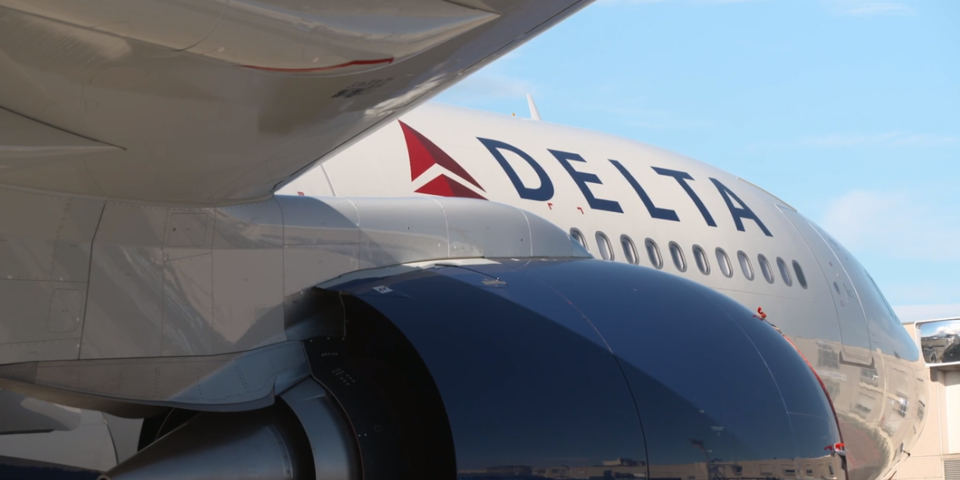
Delta Air Lines has restored its full year 2025 guidance as demand stabilises, the company said in its second quarter report on July 10, 2025.
“Through the quarter, demand trends stabilised at levels that are flat to last year and we continued to see resilience in our diverse, high-margin revenue streams,” said Delta president Glen Hauenstein in a statement.
The airline's shares had jumped 11% following the better than expected results and the news of stabilised demand.
With guidance restored, the company now expects earnings of between $5.25 and $6.25 per share for the full year 2025. Additionally, it forecasts $3-4bn in free cash flow for the year and a gross leverage below 2.5x.
This followed a stream of airlines pulling their guidance in their March-ending quarterly reports amid softening demand and economic uncertainty, exacerbated by the turbulent US-led tariff conflict.
For the third quarter, Delta expects third quarter revenues to be flat to up 4%, compared to the third quarter last year, while earnings are expected to be between $1.25 and $1.75 per share. Operating margin is forecasted to be up 9-11%.
For the second quarter, Delta reported operating revenues of $16.6bn, remaining flat on the previous year. Operating expenses for the quarter were $14.5bn, up only 1% compared to last year.
During the company's earnings call, Delta CEO Ed Bastian said overall demand “remains similar to last year with softness largely contained to main cabin and particularly during off peak periods". He added that the company's diversified revenue streams, which make up around 60% of its revenue, “remain resilient”.
Main cabin was down 5.5% in the quarter, while premium cabin revenue was up 4.7% in the quarter, signalling premium as a key driver.
Bank of America Andrew Didora said the “continued strength” in Delta’s premium revenues would be a “key differentiator” for the airline compared to “most other airlines”. The analyst added that airlines more exposed to main cabin revenue may see less upside in the second quarter.
“Main cabin has been the weakness as we move through the year and it's been very weak in off peak,” said Bastian. “What we've done — and a lot of the industry too — is we're taking the weakest trips out, which is what you would expect airlines to do. These tend to be off peak days and times… I would expect to see very favourable results for main cabin as we move through the rest of the year, given what the industry is producing too.”
Bastian said main cabin could be positive this year, or at least flat — potentially even by the third quarter 2025.
The company’s operating income fell 7% to $2.1bn, with operating margin down one percentage point to 12.6%. Pre-tax income was up 45% to $2.6bn, while net profits were up 63% to $2.1bn.
Delta's management said there is “clearly less travel coming out of Europe”, but this has been offset by currency changes. “It means lower customer accounts, but higher yields given the currency has appreciated over 10% over the past few months here," said Bastian.
He noted a change in customer attitude towards travelling in peak, high demand summer season.
“Everybody's on vacation, prices are really high, places are crowded, Europe's hot… customers are changing to times where it's a much more pleasurable experience such as cooler temperatures and lower hotel rates,” he explained. He added that this “systematic shift” is not a “one year issue” but taking place over multiple years where the peak season is “getting less peaky and the shoulders are getting stronger".
The airline expects new deliveries for this year to be around 40 aircraft and expects to retire around 30, resulting in around 10 new aircraft — or a 1% increase to its fleet. Bastian reiterated that the company is “not planning on paying any tariffs” for aircraft deliveries and said it was a “strong point of view” at the company.
This was witnessed in it leveraging a loophole for A330 and A350 deliveries by routing the jets to Tokyo before placing them on revenue flights.
As of the end of the quarter, Delta’s total debt and finance lease obligations were down 16% to $15.1bn, when compared to the end of the second quarter last year. As of the end of the quarter, the company had a liquidity of $6.4bn, including $3.1 in undrawn revolver capacity.