

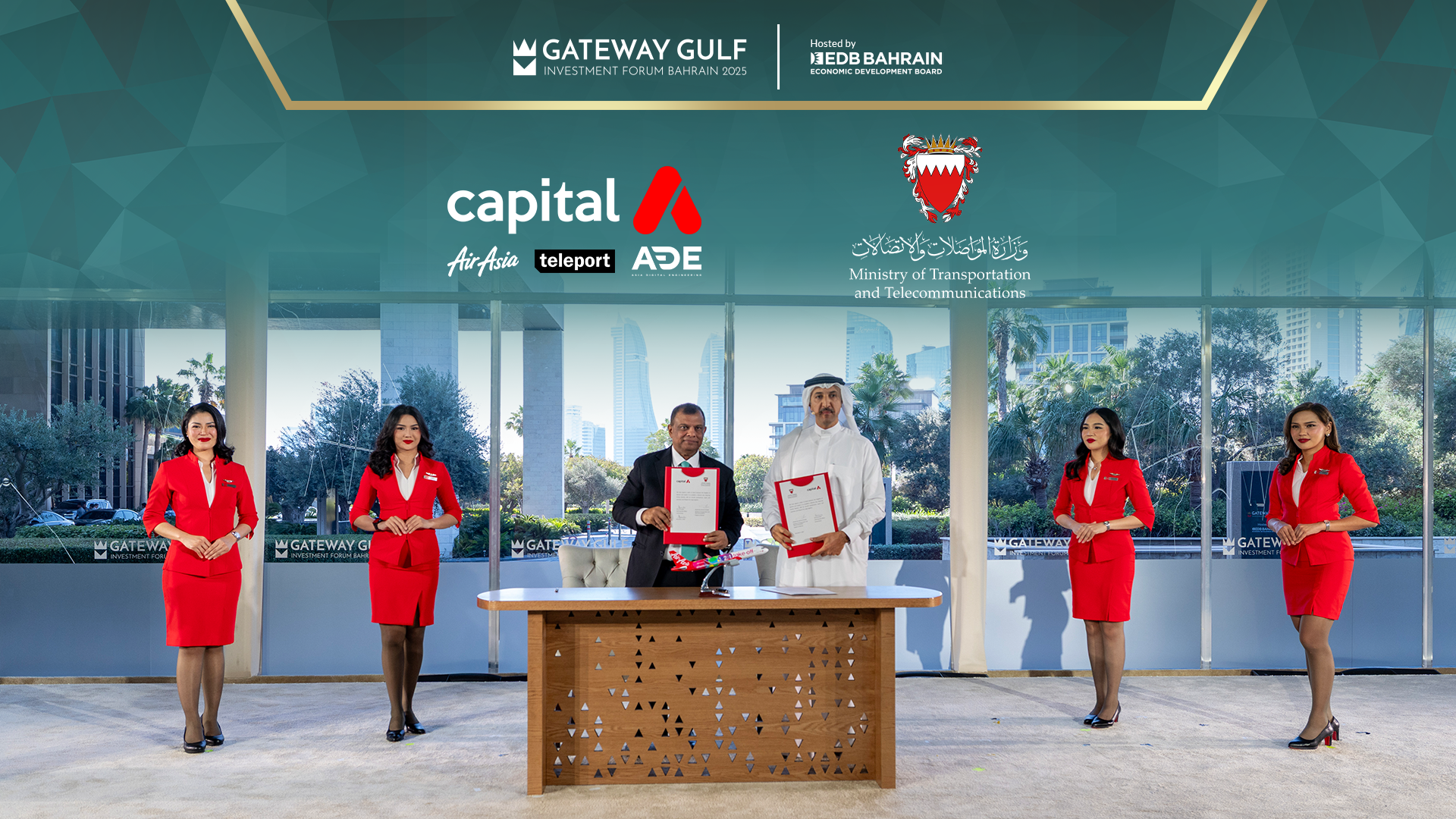
Capital A Berhad has signed a letter of intent (LOI) to explore the possibility of making Bahrain its Middle East hub for aviation, maintenance and logistics.
The LOI, signed with Bahrain’s Ministry of Transportation and Telecommunications, could lead to a long-term partnership that will establish Bahrain as a key nexus between the Middle East and ASEAN.
The agreement sets out a comprehensive framework for deeper aviation and economic cooperation between Bahrain and Capital A, owner of AirAsia, with a shared ambition to open new routes between the two regions.
It outlines potential collaborations across future airline operations, cargo and logistics, maintenance capabilities and talent development.
Tony Fernandes, CEO of Capital A, described the agreement as a “game changer” both for Capital A and for Bahrain’s aviation sector.
“With our aviation restructuring soon to be complete, both Capital A and AirAsia are stepping into another bold and disruptive chapter of global growth, and Bahrain will be a powerful launchpad for us in the Middle East,” he said.
By 2030, in addition to potentially operating a hub in Bahrain, Air Asia expects to operate over 25 daily flights between Bahrain and its ASEAN “megahubs”.
These flights are expected to carry over 20 million passengers over the next five years, and to contribute BHD 3 billion (USD 8 billion) to Bahrain’s economy.
Under the LOI, AirAsia will explore launching flights from Malaysia, Thailand, the Philippines and Indonesia to Bahrain, with onward connectivity to Europe and the US.
The Group will also evaluate the possibility of operating narrowbody aircraft from the Bahrain hub into key cities in the Middle East, Central Asia, Africa and Europe.
This expansion is expected to support over 100,000 jobs across Bahrain’s aviation and services ecosystem.
“The future of travel is multi-hub, seamless and borderless,” said Fernandes. “There will be new flows of people, trade, talent and cargo, not just between major capitals but into fast-growing secondary and emerging cities where real economic expansion happens.”