

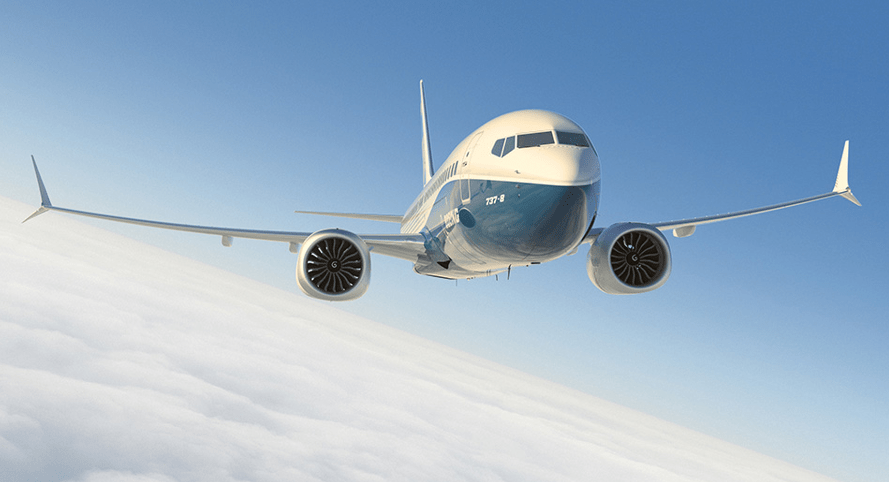
Boeing is in the early stages of planning a new narrowbody jet to succeed the 737 MAX, according to a Wall Street Journal (WSJ) report, citing people familiar with the matter.
The report claims that Boeing CEO Kelly Ortberg met with Rolls-Royce earlier this year to discuss a new engine to power the aircraft.
The engine manufacturer had reportedly pitched an engine that could provide an increase in fuel efficiency by around 10% compared to A320neo engines. The A320neo is powered by CFM International LEAP-1A and Pratt & Whitney’s geared turbofan (GTF) PW1100G engines.
The engine will play a significant role in this aircraft, according to Alton Aviation Consultancy managing director John Mowry, who told Airline Economics: “We perceive the ability to come to market with an economically compelling aircraft will hinge to a significant extent on engine technology availability (which may in turn contribute to the requirement for new airframe fuselage design).
"Boeing has had a long-term exclusive relationship for its 737 programme with CFM. The business case would likely need to be very compelling for CFM to bring to market a new product in the near-term.”
Mowry noted that the LEAP-1A/1B programme is currently enjoying a huge backlog with “lucrative aftermarket support revenues” that is expected to run for decades.
Meanwhile, Pratt & Whitney is bringing the GTF engine’s durability to industry standard. Mowry said that launching a replacement now could limit the programme’s ability to generate targeted returns.
“Rolls-Royce, which is no longer a participant on either programme, would seem to have the most to gain by bringing to market a new engine,” said Mowry.
“Rolls engines were historically on some 747s and 757s, and more recently have been an option on the 787, but the experience with those Trent 1000 engines has been challenging for some customers, and that experience is likely to be considered in the minds of Boeing executives as they contemplated engine selection.”
Boeing and Rolls-Royce did not respond to separate requests for comment.
After a tumultuous year in 2024 — contending with regulatory oversight and production caps in the fallout from the Alaska Airlines Flight 1282 incident, along with a seven-week-long strike — Boeing has been diligently working to improve.
So far in 2025, the US aircraft assembler has been steadily stabilising its production. The monthly production cap on the 737 MAX jet imposed by the Federal Aviation Administration (FAA) is expected to increase from 38 per month to 42 in this fourth quarter.
The news of this early-stage planning for a clean-sheet design signals the company’s more stabilised position and growing confidence.
However, as Boeing continues to grapple with its immense backlog of over 5,000 aircraft and a debt of just over $50bn, a new aircraft programme would be time-consuming and costly.
“Given the very long development life cycle of new aircraft programs, the current constrained supply chain environment shouldn't be a major factor in Boeing's decision-making process,” said Mowry.
“As demonstrated by the venerable Boeing 737 family, airframe programmes with derivatives can have extended life cycles of 60 years or more and therefore require significant long-term thinking.”
Recent aircraft programmes — such as the A320neo, A220, 737 MAX and E2 family — were driven by the ability to provide a 15% fuel burn improvement when compared to their respective predecessor.
“While the OEMs hit the mark on fuel burn savings, with moderated fuel prices, the relative attractiveness has been more limited, and lower engine durability and higher engine maintenance costs have been a frustration for the industry, partially offsetting the economic gain,” said Mowry.
As reports swirl around a new aircraft from Boeing, the OEM is continuing to face delays on certification of the 7 and 10 variants of its 737 MAX.
The 737 MAX 10’s first test flight took place in June 2021, but its certification — along with the MAX 7 — is expected in 2026. Additionally, certification of the 777X was pushed back from 2020 to around early- to mid-2026.
“Most certainly, Boeing will take away lessons learned from the recent 737 MAX and 777X certification processes, though the last clean-sheet certification was the Boeing 787,” said Mowry. “Even if a new programme is launched by Boeing, history suggests entry into service may be quite some time away.”
On a broader level, Boeing is at an uplift — shedding much of the challenges and moving towards a more optimistic future. The early stage of a clean-sheet aircraft programme may stand as a testament to this path forward.
“Given an almost decade-long run of bad news and negative press, the new CEO needs both employees and shareholders to be excited and hopeful about the future, and not singularly focussed on fixing the challenges of the past,” said Mowry.
Ortberg — the former chief executive of Rockwell Collins — assumed the role of Boeing’s CEO in August last year. His experience and engineering background was seen as a move that would position Boeing back to its roots. He succeeded Dave Calhoun, who served as CEO since January 2020.