

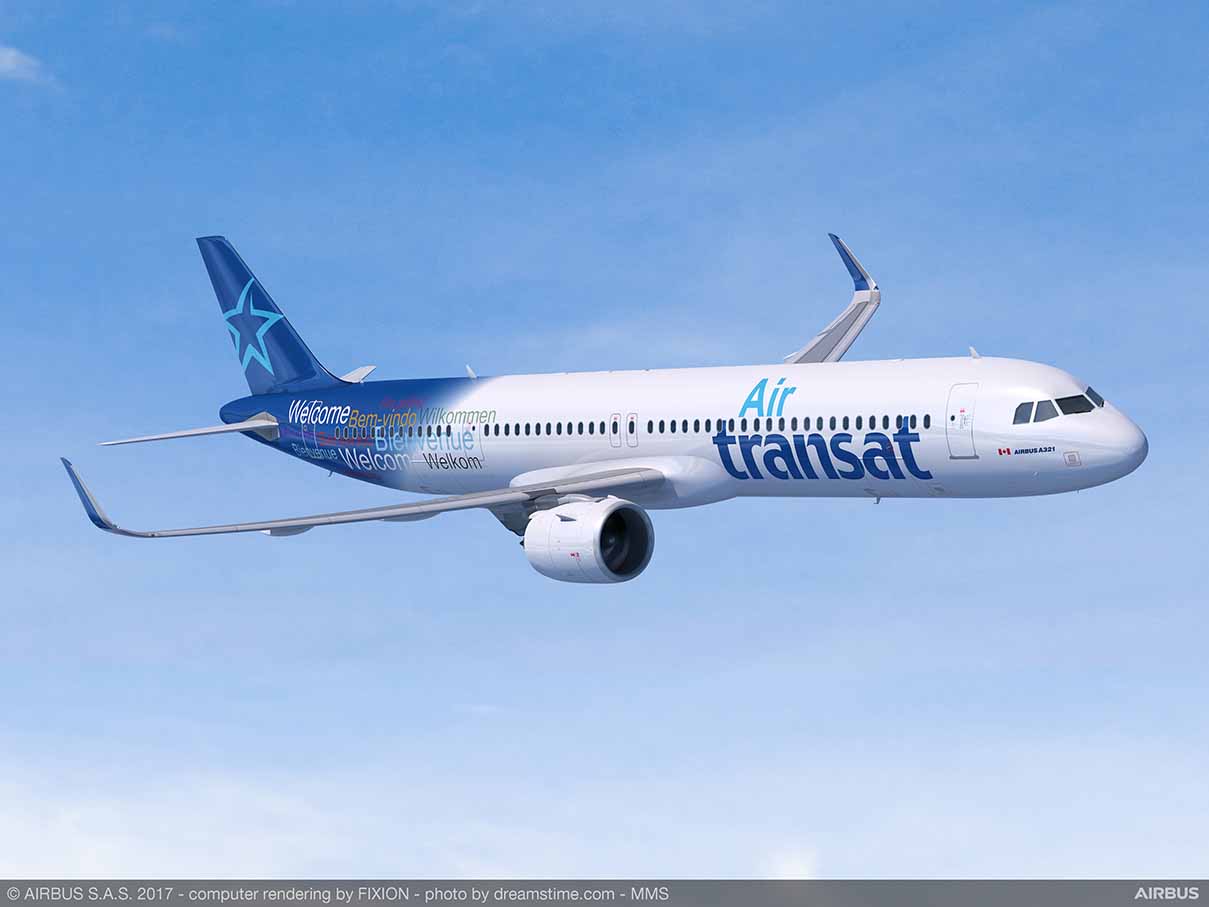
Canadian carrier Air Transat's shares tumbled on Thursday March 13 after it reported disappointing results.
The airline's net losses doubled in its first quarter 2025 — ending January 31, 2025 — to C$122.5 million ($84.9 million), compared to C$61 million ($42.3 million) in the same period a year prior.
The company's yield improved only 1.7% in the period, as well as capacity mostly flat at a positive 0.5%. Revenues were up 5.6% to C$829.5 million ($574.9 million). Operating loss improved only marginally from C$52.4 million ($36 million) a year prior to C$52 million ($36.3 million).
Transat CEO and president Annick Geurard said: “The refinancing of our debt of more than C$800 million [$554.3 million] and the strengthening of our balance sheet remain our top priorities.”
The company began discussions with the federal government — its main lender — over 18 months ago and has still not come to a resolution. The company said that due to the “complexity” of these discussions, the company extended the maturity dates of its subordinated and secured Canadian government financing agreements to April 2027 and November 2026, respectively.
The company also renegotiated its revolving credit facility maturity date to November 2026. Geurard said this would provide the company more flexibility as it navigates its debt situation. As of January 31, 2025, the company had a total net debt of C$1.9bn ($1.3bn).
The company said its fleet was severely impacted by the Pratt & Whitney geared turbofan (GTF) engine issue.
“The number of grounded aircraft has fluctuated between six and seven during the last quarter and we anticipate this level of AOG [aircraft on ground] to persist throughout the year,” said Geurard.
Air Transat has a fleet of 44 aircraft (including one dry lease) for the winter season and 43 aircraft for the summer. The company said it has no aircraft deliveries planned for this year.
“We continue to press for the conclusion of an agreement with Pratt & Whitney regarding the grounded aircraft for 2025,” added Geurard.
The company's CFO Jean Francois Pruneau said the company received net proceeds of nearly C$31 million ($21.5 million) from the sale and leaseback of a Ford spare engine it obtained as compensation from Pratt & Whitney due to operational disruptions during the 2023 and 2024 period.
Adjusted EBITDA swung to a positive C$20 million ($13.9 million), compared with a negative C$3.3 million ($2.3 million) a year ago. This was driven by revenue growth as well as a 15% decrease in fuel prices, and lower aircraft rent expenses. However, the company said capacity expansion had slightly offset these improvements.
Despite the announcement of tariffs from US president Donald Trump, the company said it is “closely monitoring the situation as it evolves".
“Besides the US market, which remains a very small market for us with only two destinations that we operate on Florida, we have seen yet other negative impact on our booking curve following tariffs announcement,” said Guerard.
She added: “We are well aware that the current environment is affecting overall consumer confidence and this could eventually affect travel demand, but we haven't seen any impact over the last weeks on the bookings."
The company said it has decided to deploy “limited capacity” to have a more disciplined approach, echoing sentiments from US airlines that seem to be focussing on profitable routes over market share.
However, the company did highlight its twice weekly flights from Toronto to Berlin launching in summer, as well as introducing Valencia and Montreal to its network from June 2025, as well as a new partnership with Air Europa to strengthen its presence in the “growing Spanish travel market” via Air Europa's Madrid hub.
Furthermore, Guerard said she would “not be surprised” if there are more last-minute bookings this year, given the uncertain economic environment. “People will potentially hesitate before making any bookings to better understand what's going to happen with the economic environment,” she said. “But we're going to touch wood… things are looking good for now.”
Guerard said the company is seeing more positive yields as it looks into the second quarter, which is currently “a little bit more” than 2%, noting particular strength in the Atlantic market.