

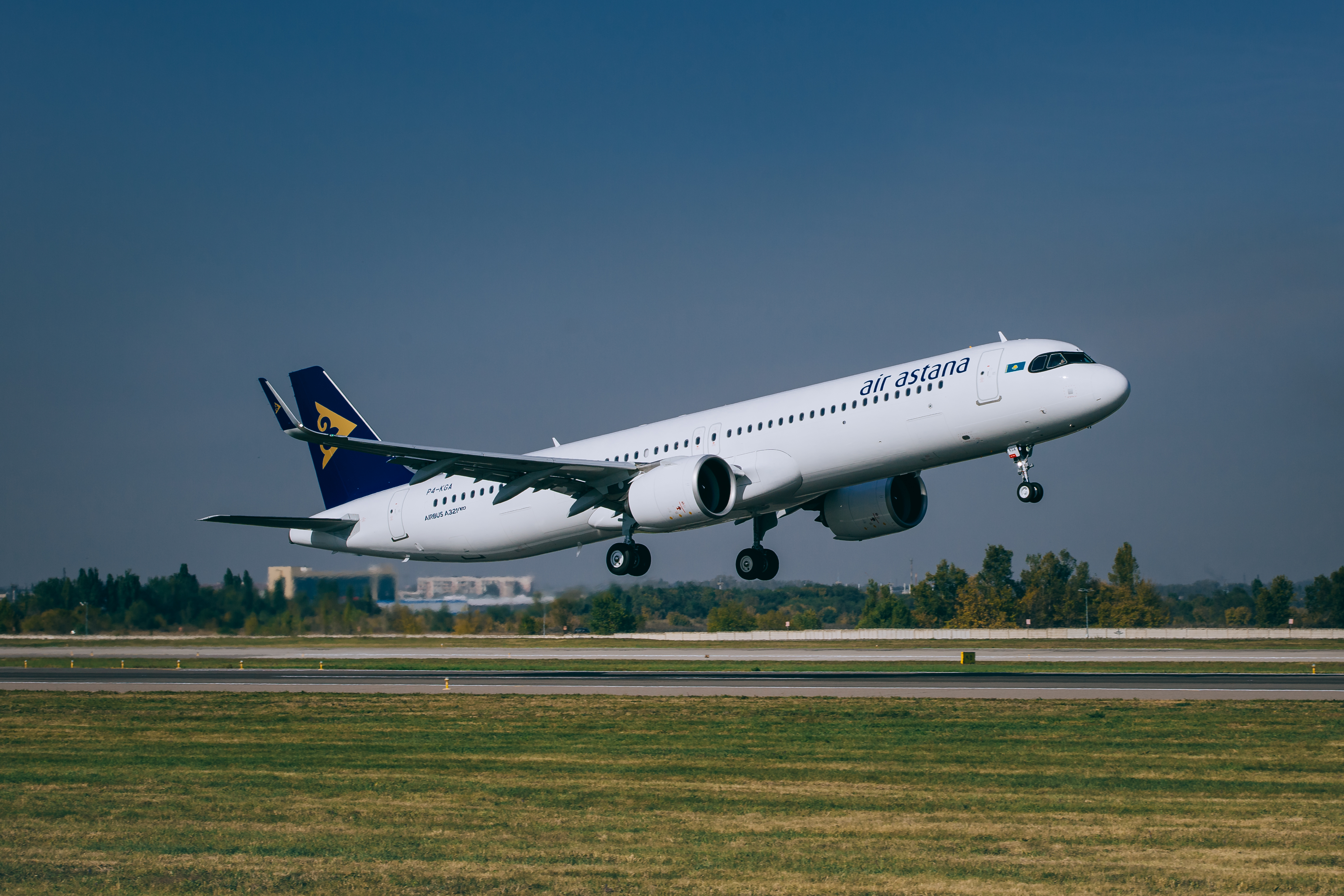
Air Astana reported strong revenue and EBITDAR growth in the first quarter of the year, despite a seasonally weaker period.
Revenues were up 10.4% to $292.4 million. The airline's EBITDAR was up 37.1% to $59.9 million, while EBITDAR margin improved four percentage points to 20.5%. Additionally, while revenue per available seat kilometre (RASK) was down 2.7% to 6.23 cents, cost per available seat kilometre (CASK) was down 5.7% to 6.09 cents.
“The positive RASK-CASK trend continued and once again proved the effectiveness of our natural currency hedge,” said Air Astana Group CEO Peter Foster. “These results were achieved despite the [Kazakhstani] tenge depreciation and earlier Ramadan this year, driven by particularly strong international key markets in Asia.”
The airline added 15 new routes for 2025 to high demand business and leisure locations. Additionally, the company expanded its fleet to 60 aircraft with the delivery of five A320 family aircraft in 2025. Two of its three remaining E2 aircraft have been phased out, which will bring to a close its fleet simplification plan.
Due to delivery and production delays at Boeing, Air Astana said the delivery of its first 787-9 Dreamliner aircraft has been pushed back to the second half of 2026.
“We are continuing to invest in our in-house capabilities to further improve the Group’s efficiency as a platform for our growth strategy," added Foster. "In line with our mitigation plan, we are proactively resting Pratt & Whitney engines in the low season and adding capacity to those routes with the strongest demand such as China, India, Middle East, Turkey, Georgia, South Korea and Europe.”
The company said it had a “positive outlook” for summer based on forward bookings, along with its additional fleet and GTF engine mitigation plan. The airline currently has 12 spare engines to support its A320neo family fleet.
“The engine-off wing time assumption for this issue remains 18 months,” the airline read in its report. “Although the group is now being delivered completely fault-free engines, the issue is expect to persist and require proactive mitigating actions for the foreseeable future.”
Air Astana said its compensation and support agreements with Pratt & Whitney are “particularly important” to mitigate costs and capacity constraints from GTF-related aircraft on ground (AOG).
The company's load factor improved marginally by 0.3 percentage points to 81.5%, while passenger numbers during the quarter climbed 7.1% to 2 million.
As of the end of the quarter, the company had $513.7 million in cash and bank balances, along with a net debt to EBITDAR of 1.4x, up 0.2 percentage points compared to the same period last year.