
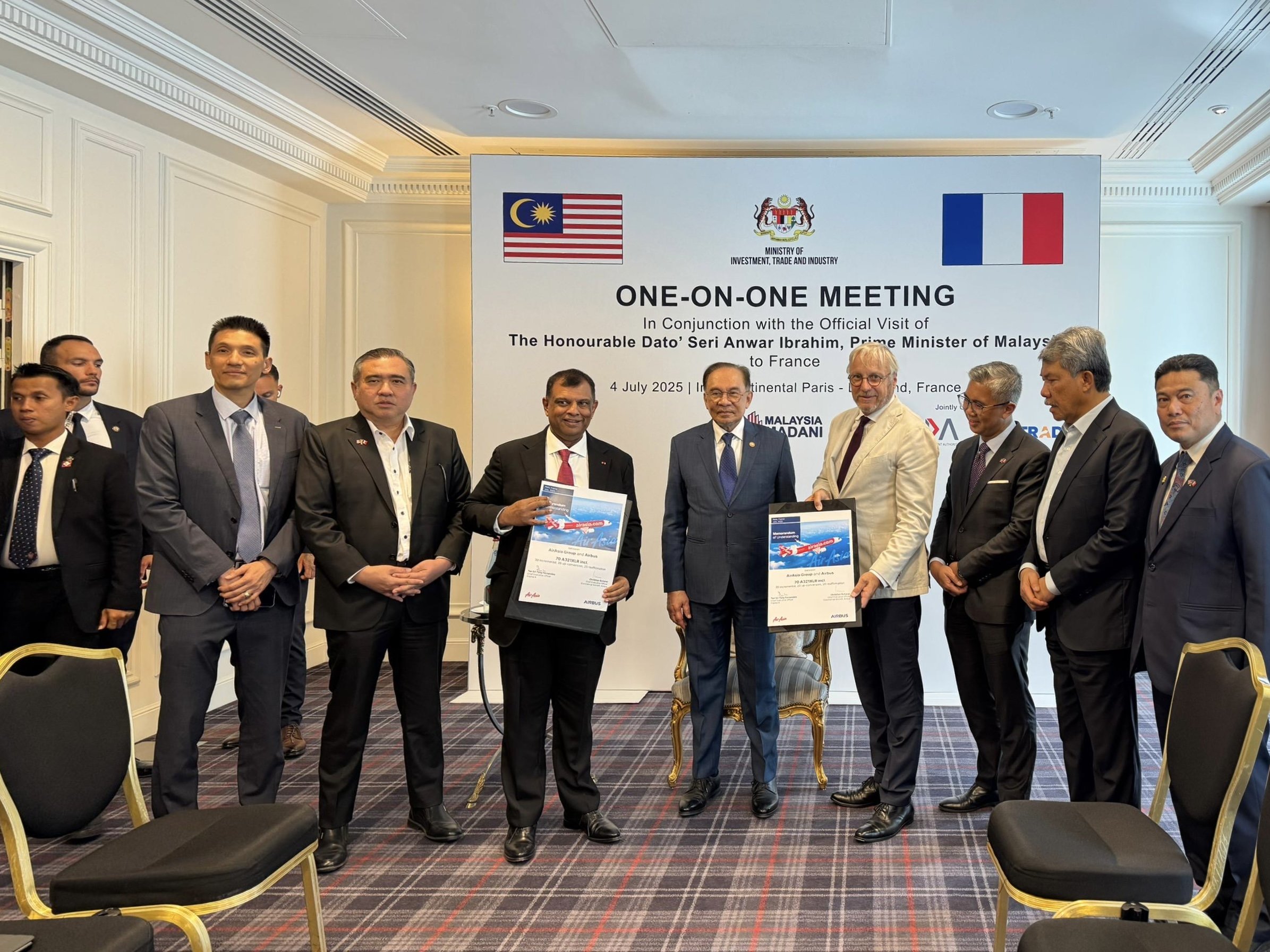
AirAsia Berhad, a wholly-owned subsidiary of Capital A Berhad, has signed a landmark agreement with Airbus valued at $12.25bn for 50 A321XLRs with rights for 20 more. The aircraft are scheduled for delivery commencing 2028 through 2032.
Witnessed by Prime Minister of Malaysia YAB Dato’ Seri Anwar Ibrahim, the agreement was signed on July 5 in Paris between Tony Fernandes, CEO of Capital A, and Christian Scherer, CEO of Airbus Commercial Aircraft.
Tony Fernandes, CEO of Capital A and Advisor & Steward of AirAsia Group, said that the airline that had “pioneered low-cost travel in Asia” is continuing its “transformative journey to become the world’s first low-cost network carrier”. He said that AirAsia was targeting “exponential growth” but by connecting geographies beyond Asean, the airline claims to be making flying even more democratic. “We gave people in Asean the opportunity to explore Asia – now we want the world to see Asean, and Asean to see the world,” says Fernandes. “The A321XLR and A321LR are the game-changers enabling this vision, and we are proud to lead the charge in making our world smaller. We can’t wait to paint the skies even wider in red.”
Christian Scherer, CEO Commercial Aircraft at Airbus, commented that the “A321XLR unlocks new opportunities for AirAsia to launch non-stop flights linking primary and secondary cities all around the globe”.
The A321XLRs will operate alongside AirAsia’s all-Airbus fleet of A320 Family and A330 aircraft, supporting its long-term strategy to deliver connectivity across Asia and beyond, while maintaining a low-cost model through improved route economics, enhanced aircraft utilisation and fleet efficiency. AirAsia Group aims to carry 150 million guests annually by 2030. AirAsia said that the new fleet plays a “pivotal role” in its transformation, enabling the airline to match capacity with demand, reduce fuel consumption, and support a sustainable, cost-effective growth model in a highly competitive global landscape. The A321XLR also offers up to 20 per cent lower fuel burn per seat than the A321neo, significantly improving emissions performance and operating efficiency.